
Skip to main content Skip to navigation
Back to top anchor
Home Department of the Prime Minister and Cabinet (DPMC)
Page url
  • Careers
  • Media
  • Contact us
  • Home
Open search Close search
  • Contact us
    • How to make an Official Information Act request
      • Tips for requesting information
      • Guidance on how we will respond
  • About DPMC
    • Who we are
    • Our work
    • Our history
    • Careers
  • Our business units
    • Cabinet Office
      • Roles and responsibilities
        • Statutory and formal responsibilities
      • Supporting the work of the Cabinet
        • Cabinet Committees
        • Elections
        • Cabinet Manual
          • Publication information
          • Foreword
          • Preface
          • Introduction
          • 1. Sovereign, Governor-General, and Executive Council
            • Introduction
            • Sovereign of New Zealand
            • Governor-General
            • Executive Council
            • Clerk of the Executive Council
            • Meetings of Executive Council
            • Gazetting and entry into force
            • Announcement
            • New Zealand Royal Honours System
            • Heraldry
            • Order of Precedence
            • Related Information
          • 2. Ministers of the Crown: Appointment, Role, and Conduct
            • Introduction
            • Prime Minister
            • Deputy Prime Minister
            • Ministers
            • Parliamentary Under-Secretaries
            • Parliamentary Private Secretaries
            • Conduct, public duty, and personal interests
            • Interactions with representatives from non-government or commercial organisations
            • Personal email accounts and phone numbers
            • Gifts and awards
            • Speaking engagements, endorsements, and non-ministerial activities
            • Government advertising and publicity guidelines
            • Ministerial travel
            • Related Information
          • 3. Ministers of the Crown and the Public Sector
            • Introduction
            • The public service and the public sector
            • Ministers and the public service
            • Ministers and Crown entities
            • Ministers and companies in the public sector
            • Integrity and conduct throughout the public sector
            • Related Information
          • 4. Ministers, the Law, and Inquiries
            • Introduction
            • Attorney-General
            • Comment by Ministers on judicial decisions
            • Crown legal business
            • Litigation involving Ministers
            • Legal advice and legal professional privilege
            • Inquiries
            • Related Information
          • 5. Cabinet Decision-making
            • Introduction
            • Cabinet
            • Cabinet committees
            • Principles of Cabinet decision-making
            • Cabinet and Cabinet committee procedures
            • Secretary of the Cabinet and the Cabinet Office
            • Related Information
          • 6. Elections, Transitions, and Government Formation
            • Introduction
            • The electoral cycle
            • Transitions following an election
            • Caretaker convention
            • Government formation
            • Mid-term transitions
            • Early election
            • Provision of information by the state sector during transitions
            • Related Information
          • 7. The Executive, Legislation, and the House
            • Introduction
            • Speech from the Throne
            • Prime Minister's statement
            • Government legislation programme
            • Revision Bills
            • Law Commission work programme
            • Development and approval of bills
            • Secondary legislation
            • Ministers and the House
            • Ministers and select committees
            • Parliamentary treaty examination
            • Crown's financial veto
            • Citizens initiated referenda
            • Declarations of inconsistency
            • Related information
          • 8. Official Information and Public Records
            • Introduction
            • Information held by government
            • Official Information Act 1982
            • Privacy Act 1993
            • Ombudsmen Act 1975
            • Providing information to select committees
            • Production or discovery of official documents
            • Requests for parliamentary information
            • Ministers and Public Records
            • Disclosure and use of official information by former Ministers
            • Convention on access to Cabinet records of a previous administration
            • Related Information
          • Appendix A: The Treaty of Waitangi/Te Tiriti o Waitangi
          • Appendix B: Letters Patent Constituting the Office of Governor-General of New Zealand 1983
          • Index
        • History of the Cabinet Manual
      • Ministers and their portfolios
        • Ministerial List
        • Ministerial portfolios
          • Briefings to incoming ministers (BIMs)
          • Directory of Ministerial portfolios
        • Register of Assigned Legislation
        • Delegations
        • Ministers' interests
          • Ministers' Interests Jul 2025 - Dec 2025
          • Ministers' Interests Jan 2025 - Jun 2025
          • Ministers' Interests May 2024 - Dec 2024
          • Ministers' Interests 2023-2024
          • Ministers' Interests 2022-2023
          • Ministers' Interests 2021-2022
          • Ministers' interests 2020-2021
          • Ministers' Interests 2019-2020
          • Ministers' Interests 2018-2019
          • Ministers' interests 2017-2018
          • Ministers' interests 2016-2017
          • Ministers' interests 2015-2016
          • Ministers' interests 2014-2015
          • Ministers' interests 2013-2014
          • Ministers' interests 2012-2013
      • Executive Council
      • The Honours Unit
    • National Security and Resilience Group
      • National Assessments Bureau
        • Working for the National Assessments Bureau
      • National Risk and Resilience Directorate
      • National Security Policy and Coordination
      • Strategic Crisis Management Directorate
    • Policy Advisory Group
      • Roles and responsibilities
    • Delivery Unit
    • Corporate
    • Government House
  • Our programmes
    • New Zealand Royal Honours
      • Make a nomination
        • Nominations for Honours
        • New Zealand Royal Honours nomination guidelines
        • Nomination Form and Guide to making Nominations
        • Bravery Award Nominations
        • The New Zealand Antarctic Medal: Nomination Guidelines
      • Honours lists and recipients
        • Honours lists
          • Current Members of the Order of New Zealand
          • Knights and Dames of the New Zealand Order of Merit
          • Knights and Dames of the Orders of Chivalry
          • The New Zealand Gallantry Awards
          • The New Zealand Bravery Awards
          • The New Zealand Antarctic Medal
          • The Privy Council
        • Titles and styles of knights and dames
        • Wearing of insignia
          • Order of wear: orders, decorations and medals in New Zealand
          • Method of mounting insignia
      • The New Zealand Royal Honours system
        • Overview of the New Zealand Royal Honours system
        • Forfeiture of Honours
        • History
        • Components of the New Zealand Royal Honours system
          • The Order of New Zealand
          • The New Zealand Order of Merit
          • The King's Service Order
          • Gallantry and Bravery Awards
            • New Zealand Gallantry Awards
            • New Zealand Bravery Awards
          • The New Zealand Antarctic Medal
          • The New Zealand Distinguished Service Decoration
          • Other distinctive New Zealand Honours
          • "The Right Honourable"
            • The Right Honourable in New Zealand
          • "The Honourable"
            • Roll of The Honourables
          • Privy Council
        • Order of Wear
        • Rules relating to the acceptance and wearing of Foreign Honours
        • New Zealand Herald of Arms Extraordinary
      • New Zealand Royal Honours Image Gallery
      • New Zealand Royal Honours FAQs
      • Privacy and AI use statement
    • The Policy Project
      • About the Policy Project
      • Policy quality
      • Policy skills
        • Development Pathways
          • Use the tool
      • Policy capability
      • Policy Tools
        • Start Right
        • Design thinking
          • Journey mapping
          • Role play
          • Prototyping
          • Experience interviews
          • Personas
        • Behavioural insights
          • Behavioural Change Models
        • Community engagement
          • Citizen juries
        • Futures thinking
          • Horizon Scanning
          • Assumption Testing
          • Futures Wheel
          • Scenarios
          • Wind Tunnelling
          • Backcasting
        • Treaty of Waitangi analysis
      • Long-term Insights Briefings
      • Policy advice themes
        • Engagement
        • Evidence and evaluation
        • Free and frank advice
        • Innovation
        • Policy and law
        • Stewardship
      • Policy community
        • Policy system leadership
        • Policy agencies
        • Policy managers
        • Policy practitioners
        • Ways to connect to the policy community
        • Open government
      • Agency panels and quality reporting
      • Publications
      • Policy community events
    • Government Targets
      • Government Targets Quarterly Reports
    • National security
      • New Zealand's National Security Strategy
        • New Zealand’s national security community
      • National Security Intelligence Priorities
      • Counter-terrorism
        • New Zealand's Countering Terrorism and Violent Extremism Strategy
        • Preventing and Countering Violent Extremism Fund
        • Preventing and Countering Violent Extremism Research
        • Terrorist and National Security Event Media Protocols
      • Countering foreign interference
      • Critical Infrastructure
        • Critical Infrastructure Resilience
      • Cyber Security Strategy
        • Cyber ransom advice
        • United Nations Cybercrime Treaty
          • We asked, you said, we did
      • Intelligence and Security Act 2017
        • 2022 Review of the Intelligence and Security Act 2017
        • Why did we need new legislation?
        • What is intelligence?
        • Defining national security
        • Bringing the agencies further into the public service
        • Powers and warrants
          • Activities allowed under intelligence warrants
          • The authorisation framework
          • Protections for New Zealanders
        • Strengthening oversight of NZSIS and GCSB
        • Whistleblowing and protecting classified information
        • Cover and immunities
          • Cover and assumed identity arrangements
          • Immunities from legal liabilities
        • Sharing information
          • Domestic information sharing
          • Arrangements with foreign partners
        • The National Assessments Bureau
        • Case studies
          • Counter-terrorism
          • Investigating a suspected terrorist
          • Counter-espionage
          • Cyber security in action
        • Resources
      • Strengthening resilience to disinformation
        • Multi-Stakeholder Group to strengthen resilience to disinformation
        • Fund for community-based initiatives to strengthen Aotearoa’s resilience to disinformation
        • Public Research and Insights into Disinformation
      • National Security Long-term Insights Briefing
        • LTIB Topic Consultation Summary
      • Royal Commission of Inquiry into the terrorist attack on Christchurch masjidain
        • The Government’s Response
        • Working with Communities - get involved
          • Kāpuia - Ministerial Advisory Group Nominations
        • Response Steering Group
        • Response Progress
        • Measuring Success
        • Improving Community Engagement
        • Key Documents
        • Get in touch
      • Five Country Ministerial
    • Other work
      • Prime Minister's Chief Science Advisor
        • Meet Dr John Roche, Prime Minister's Chief Science Advisor
        • Prime Minister's Chief Science Advisor archives
          • Archive
            • Professor Sir Peter Gluckman 2009-2011
            • Professor Sir Peter Gluckman 2011-2013
            • Professor Sir Peter Gluckman 2013-2015
            • Professor Sir Peter Gluckman 2015-2018
            • Professor Dame Juliet Gerrard 2018-2021
            • Professor Dame Juliet Gerrard 2021-2024
      • Chief Science Advisor Forum
      • Severe Weather Events Recovery Review Panel releases
      • Historical Programmes
        • NEMA
        • Cyclone Recovery Unit
          • Cyclone Recovery Funds and Schemes for people in Affected Regions
          • Publicly released Cyclone Recovery-related documents
        • He Whenua Taurikura
          • He Whenua Taurikura Hui
            • He Whenua Taurikura Hui 2021
            • He Whenua Taurikura Hui 2022
          • Master’s Scholarship
            • Master's Scholarship 2021/2022
            • Master's Scholarship FAQs
          • He Whenua Taurikura Co-Directors
        • Greater Christchurch recovery and regeneration
          • Greater Christchurch Group
            • Roles and responsibilities
              • Disestablishment of CERA
            • External websites
          • The Greater Christchurch Regeneration Act 2016
          • Our regeneration partners
          • Global Settlement Agreement with Christchurch City Council
          • Recovery and regeneration plans
            • Cranford Regeneration Plan
            • Ōtākaro Avon River Corridor Regeneration Plan
            • Lyttelton Port Recovery Plan
            • Residential Red Zone Offer Recovery Plan
            • Land Use Recovery Plan
            • Christchurch Central Recovery Plan
          • Section 71 proposals
            • Commercial film or video production facilities in Christchurch – Section 71 Proposal
            • Hagley Oval
            • Lyttelton Commercial Zone Parking
            • Yaldhurst Recreation and Sports Facility
            • Residential Unit Overlay District Plan Changes
            • Redcliffs School relocation
          • Christ Church Cathedral Reinstatement Project
          • Past Orders in Council
        • COVID-19 Proactive Releases
        • Kāpuia – Ministerial Advisory Group
          • Advice from Kāpuia
          • Kāpuia feedback to agencies
          • Kāpuia Pānui
        • All of Government COVID-19 Royal Commission of Inquiry
        • Child Wellbeing and Poverty Reduction
          • Child Wellbeing and Poverty Reduction Group
          • Child and youth wellbeing strategy
            • Publications and resources
          • Reducing child poverty
            • Formal gazetting of targets for reducing child poverty
        • COVID-19 Group
        • Health Transition Unit
        • Implementation Unit
          • Latest news and updates
        • Inquiry into the EQC
        • Connect Smart
        • Canterbury Earthquake Recovery Learning and Legacy Programme
        • Ministerial Committee on Poverty
        • Flag consideration project
        • Christ Church Cathedral Working Group
        • Tackling methamphetamine
        • CERA website archive
          • CERA corporate information
          • CERA legislation
          • CERA media releases 2011
          • CERA media releases 2012
          • CERA media releases 2013
          • CERA media releases 2014
          • CERA media releases 2015
          • CERA media releases 2016
          • CERA official information
          • CERA public information
          • CERA publications and reports
          • CERA websites
    • Risk and resilience
      • National Risk and Resilience Framework
        • New Zealand's National Risks
        • 2024 National Risks Public Survey Report
        • 2023 National Security Survey Report
        • 2022 National Security Survey Report
      • Building Resilience to Hazards Long-term Insights Briefing
      • New Zealand’s strategic crisis response arrangements
        • The ODESC System during a crisis
  • Publications
  • Browse all sections
  • Publications
  • News and notices
  • Annual reports
  • CabGuide
  • Cabinet Manual
  • Contact us
    • How to make an Official Information Act request
      • Tips for requesting information
      • Guidance on how we will respond
  • About DPMC
    • Who we are
    • Our work
    • Our history
    • Careers
  • Our business units
    • Cabinet Office
      • Roles and responsibilities
        • Statutory and formal responsibilities
      • Supporting the work of the Cabinet
        • Cabinet Committees
        • Elections
        • Cabinet Manual
        • History of the Cabinet Manual
      • Ministers and their portfolios
        • Ministerial List
        • Ministerial portfolios
        • Register of Assigned Legislation
        • Delegations
        • Ministers' interests
      • Executive Council
      • The Honours Unit
    • National Security and Resilience Group
      • National Assessments Bureau
        • Working for the National Assessments Bureau
      • National Risk and Resilience Directorate
      • National Security Policy and Coordination
      • Strategic Crisis Management Directorate
    • Policy Advisory Group
      • Roles and responsibilities
    • Delivery Unit
    • Corporate
    • Government House
  • Our programmes
    • New Zealand Royal Honours
      • Make a nomination
        • Nominations for Honours
        • New Zealand Royal Honours nomination guidelines
        • Nomination Form and Guide to making Nominations
        • Bravery Award Nominations
        • The New Zealand Antarctic Medal: Nomination Guidelines
      • Honours lists and recipients
        • Honours lists
        • Titles and styles of knights and dames
        • Wearing of insignia
      • The New Zealand Royal Honours system
        • Overview of the New Zealand Royal Honours system
        • Forfeiture of Honours
        • History
        • Components of the New Zealand Royal Honours system
        • Order of Wear
        • Rules relating to the acceptance and wearing of Foreign Honours
        • New Zealand Herald of Arms Extraordinary
      • New Zealand Royal Honours Image Gallery
      • New Zealand Royal Honours FAQs
      • Privacy and AI use statement
    • The Policy Project
      • About the Policy Project
      • Policy quality
      • Policy skills
        • Development Pathways
      • Policy capability
      • Policy Tools
        • Start Right
        • Design thinking
        • Behavioural insights
        • Community engagement
        • Futures thinking
        • Treaty of Waitangi analysis
      • Long-term Insights Briefings
      • Policy advice themes
        • Engagement
        • Evidence and evaluation
        • Free and frank advice
        • Innovation
        • Policy and law
        • Stewardship
      • Policy community
        • Policy system leadership
        • Policy agencies
        • Policy managers
        • Policy practitioners
        • Ways to connect to the policy community
        • Open government
      • Agency panels and quality reporting
      • Publications
      • Policy community events
    • Government Targets
      • Government Targets Quarterly Reports
    • National security
      • New Zealand's National Security Strategy
        • New Zealand’s national security community
      • National Security Intelligence Priorities
      • Counter-terrorism
        • New Zealand's Countering Terrorism and Violent Extremism Strategy
        • Preventing and Countering Violent Extremism Fund
        • Preventing and Countering Violent Extremism Research
        • Terrorist and National Security Event Media Protocols
      • Countering foreign interference
      • Critical Infrastructure
        • Critical Infrastructure Resilience
      • Cyber Security Strategy
        • Cyber ransom advice
        • United Nations Cybercrime Treaty
      • Intelligence and Security Act 2017
        • 2022 Review of the Intelligence and Security Act 2017
        • Why did we need new legislation?
        • What is intelligence?
        • Defining national security
        • Bringing the agencies further into the public service
        • Powers and warrants
        • Strengthening oversight of NZSIS and GCSB
        • Whistleblowing and protecting classified information
        • Cover and immunities
        • Sharing information
        • The National Assessments Bureau
        • Case studies
        • Resources
      • Strengthening resilience to disinformation
        • Multi-Stakeholder Group to strengthen resilience to disinformation
        • Fund for community-based initiatives to strengthen Aotearoa’s resilience to disinformation
        • Public Research and Insights into Disinformation
      • National Security Long-term Insights Briefing
        • LTIB Topic Consultation Summary
      • Royal Commission of Inquiry into the terrorist attack on Christchurch masjidain
        • The Government’s Response
        • Working with Communities - get involved
        • Response Steering Group
        • Response Progress
        • Measuring Success
        • Improving Community Engagement
        • Key Documents
        • Get in touch
      • Five Country Ministerial
    • Other work
      • Prime Minister's Chief Science Advisor
        • Meet Dr John Roche, Prime Minister's Chief Science Advisor
        • Prime Minister's Chief Science Advisor archives
      • Chief Science Advisor Forum
      • Severe Weather Events Recovery Review Panel releases
      • Historical Programmes
        • NEMA
        • Cyclone Recovery Unit
        • He Whenua Taurikura
        • Greater Christchurch recovery and regeneration
        • COVID-19 Proactive Releases
        • Kāpuia – Ministerial Advisory Group
        • All of Government COVID-19 Royal Commission of Inquiry
        • Child Wellbeing and Poverty Reduction
        • COVID-19 Group
        • Health Transition Unit
        • Implementation Unit
        • Inquiry into the EQC
        • Connect Smart
        • Canterbury Earthquake Recovery Learning and Legacy Programme
        • Ministerial Committee on Poverty
        • Flag consideration project
        • Christ Church Cathedral Working Group
        • Tackling methamphetamine
        • CERA website archive
    • Risk and resilience
      • National Risk and Resilience Framework
        • New Zealand's National Risks
        • 2024 National Risks Public Survey Report
        • 2023 National Security Survey Report
        • 2022 National Security Survey Report
      • Building Resilience to Hazards Long-term Insights Briefing
      • New Zealand’s strategic crisis response arrangements
        • The ODESC System during a crisis
  • Publications
  • Browse all sections
  1. Home
  2. Publications
  3. DPMC Diversity, Equity and Inclusion Plan 2025/26
Corporate document

DPMC Diversity, Equity and Inclusion Plan 2025/26

Publication type:
Corporate document
Published by:
Department of the Prime Minister and Cabinet (DPMC)
Issue status:
Current
Issue date:
Thursday, 2 October 2025
Additional details
Publication category:
Corporate documents
Last updated:
Thursday, 2 October 2025
Copyright:
© Crown Copyright, Creative Commons Attribution 4.0 International
Formats
  • Diversity, Equity and Inclusion Plan 2025/26
    pdf
    469.71 KB

Organisation overview, context and commitment – Tā te whakahaere matawhānui, manawanui hoki#

The Department of the Prime Minister and Cabinet (DPMC) advances an ambitious, resilient and well-governed New Zealand. To achieve this we require an influential, agile and high-performing organisation in which our people feel empowered, valued and engaged.

Our aspiration is for our workforce (ōhu mahi) to reflect the diversity of New Zealand and for every person to be self-aware, culturally competent, and to feel valued at work. The way in which we work needs to value the diversity of people, thought, approach and experience. Being inclusive in how we engage with each other enables our people to feel they belong both to our community and others, that they can be themselves at work, speak up safely and contribute.

As a small organisation, small shifts in our workforce composition or in how salaries are adjusted can have a large impact on whether we achieve our DEI goals. This underscores the importance of ensuring that every action we take contributes meaningfully to creating a more inclusive and equitable workplace.

Our focus areas

Achieving fair pay and representation

Our focus is on closing pay gaps, equity in representation, and building a workplace where everyone thrives.

Attracting and growing diverse talent

Our focus is on inclusive recruitment, having clear career pathways, and empowering employees with equitable opportunities to succeed.

Embedding a culture of inclusion and belonging

Our focus is on inclusive leadership, supporting respectful and positive workplace behaviours, and building a strong sense of community.

Insights and continuous improvement

Our focus is on improved data and use of data including staff feedback, and continuous learning to shape better decisions and deliver meaningful change.

Our people

We’re a small organisation supporting the Prime Minister, the Governor-General and Cabinet, as well as the work of other ministers.

We are undergoing organisational change, which will impact the size and composition of our workforce.

The conclusion of the Cyclone Recovery Unit and several time-limited projects has also meant changes to our workforce.
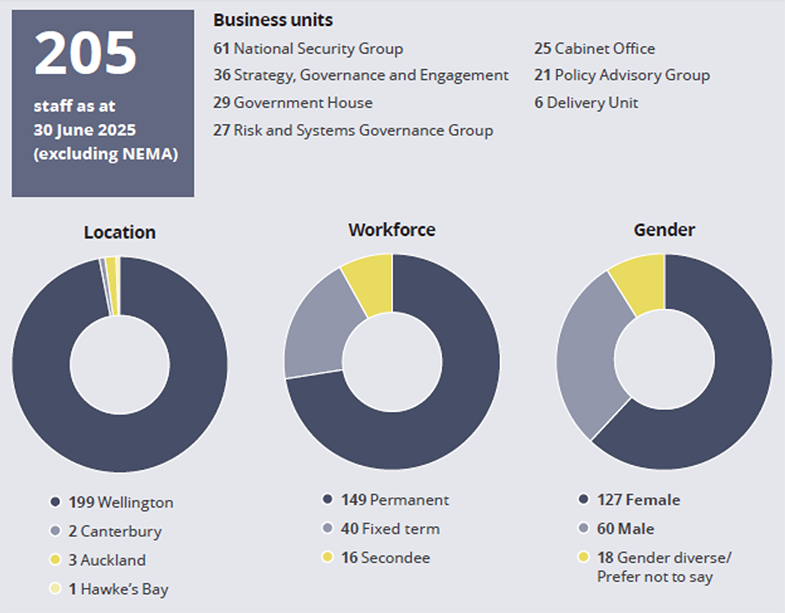
DEI Plan 2025/26 - Our people

Attracting and growing diverse talent#

Continuing our journey towards greater diversity#

We recognise the need to improve diversity within our workforce, which is predominantly European/Pākehā. Currently, the proportion of staff identifying with ethnicities other than European/Pākehā is lower than their representation in the broader New Zealand labour force.

  
Voluntary reporting of ethnic identity
EthnicityAll DPMC %
June 2024
All DPMC %
June 2025
% of the NZ
labour force
Voluntary reporting rate90.987.3-
Ethnicities reported   
European85.985.566.5
Māori7.79.114.5
Asian8.27.919.2
Pacific3.22.46.4
Middle Eastern / Latin American / African1.41.81.5
Other1.42.4-


Attracting diverse candidates and growing skillsets internally are key to making this shift. While there has been gradual improvement in staff identifying with non-dominant ethnicities, challenges remain. Although we have seen some success in attracting ethnically diverse applicants, this does not always translate into hires. We plan to explore the use of more inclusive recruitment channels and tools to address this gap.

Gender and leadership#

As of 30 June 2025, women make up the majority of our workforce and occupy 67% of all people leader roles and 74% of Tiers 2 and 3 roles.

Gender balanced leadership
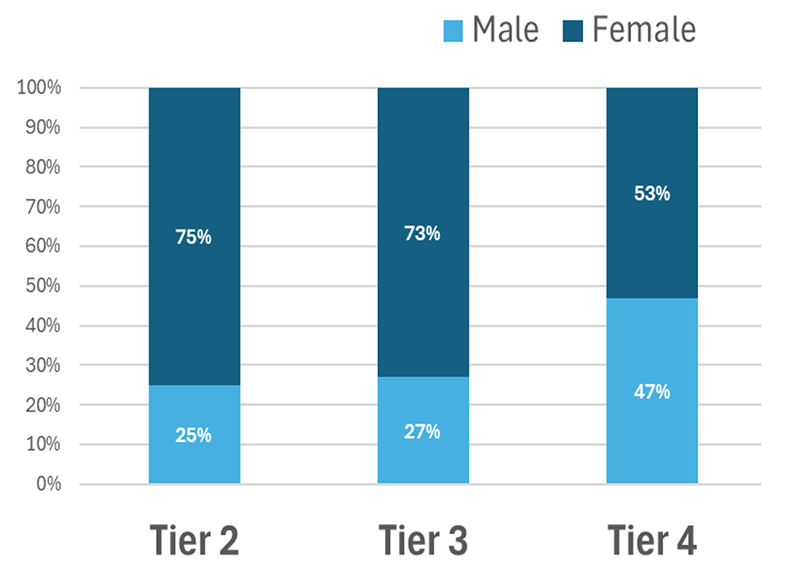
DEI Plan 2025/26 - Gender balanced leadership

Understanding our applicant data to attract diverse talent#

We are continuing to monitor and analyse applicant data to better understand how we can attract and support diverse talent, including people of other genders, the Rainbow community, neurodiverse individuals, and those with disabilities.

Enhancing ethnic representation across our workforce and leadership remains a key priority. We aim to achieve equitable representation of women, diverse genders, and ethnic groups in leadership roles. Our focus will also include increasing transparency in career pathways, identifying and addressing barriers to diversity in recruitment, and improving voluntary ethnicity reporting rates to 95%.
ThemeProgress to datePlanned actions
for 2025/26
Measures of success

Attracting and growing diverse talent 

Focus areas are inclusive recruitment, having clear career pathways, and empowering employees with equitable opportunities to succeed.

  • Leadership development resources have been created, with inclusion and accessibility guidance.
  • Promotion processes are transparent and accessible to all staff.
  • Bias training is provided for recruitment panels.
  • Flexible work policy supports diverse working styles.
  • Revise and enhance recruitment processes, practices, and guidelines to ensure we attract and enable a diverse range of applicants (e.g., accessible website designs, inclusive interview practices and accommodations, targeted attraction techniques).
  • Ensure fair, equitable, and inclusive representation of people of all genders, ethnicities, and cultural backgrounds, including Māori, in leadership positions.
  • Achieve a record of zero upheld appointment reviews on the basis of bias in the appointment process.
  • Strengthen and promote transparent career pathways and development options.
  • Improve retention and engagement of diverse staff.

Achieving fair pay and representation#

Our Gender Pay Gap (GPG) has improved#

Our average gender pay gap remains under 10%. As a smaller organisation, we place greater emphasis on analysing trends, as individual changes – such as the conclusion of the Cyclone Recovery Unit and other time-limited projects – can have a pronounced impact on our overall figures.

Gender and Ethnic Pay Gap September 2022 to June 2025
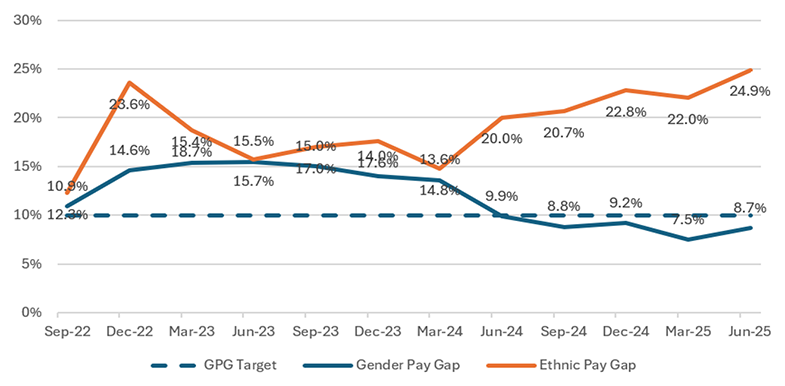
DEI Plan 2025/26 - Gender and Ethnic Pay Gap September 2022 to June 2025

The mean gender pay gap (GPG) of 8.7% reflects the average pay difference between men and women, while the higher median GPG of 23.7% highlights the uneven distribution of women across pay bands. A significant proportion of women are in lower pay bands (grades 17 and below), driving up our median GPG. Tracking both measures is crucial to understanding pay equity, as they reveal both average differences and the impact of workforce distribution, even in an organisation with strong female representation overall.

Gender Pay Gap June 2025
Gender pay gap Mean8.7%
Gender pay gap Median23.7%

We face a vertical equity challenge#

When comparing the salaries of women and men within the same grade, there is no evidence of a significant pay gap. Across all grades, the 'horizontal' gender pay gap (GPG) for permanent staff is either negligible or slightly positive, with any differences being justifiable.

Mean total remuneration by pay grade and gender (permanent staff) June 2025
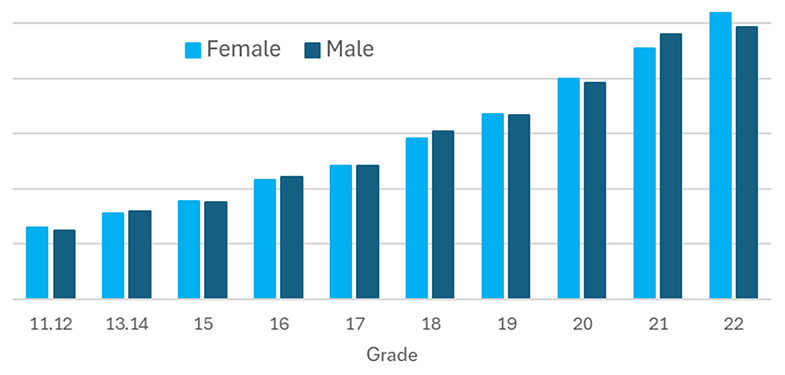
DEI Plan 2025/26 - Mean total remuneration by pay grade and gender for permanent staff - June 2025

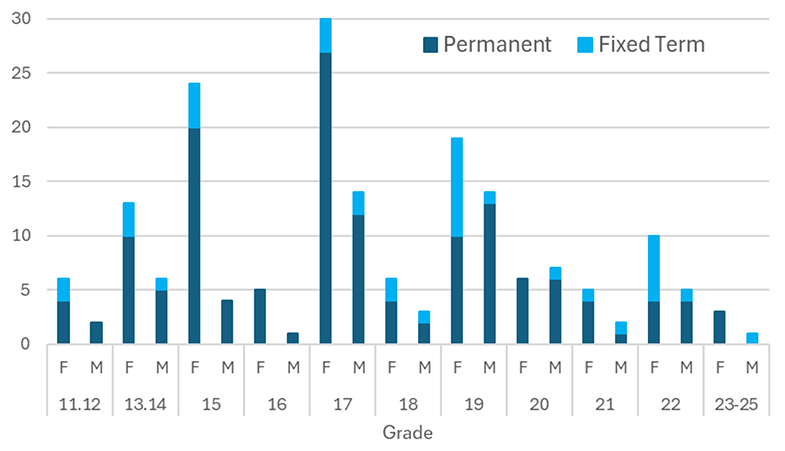
The 'vertical' challenge for DPMC lies in the fact that there is a significantly higher proportion of women in grades 17 and below compared to men. While this is a positive indicator for policy and advisory-level roles with clear career pathways, it does have an impact on our overall median GPG.

Employees by grade, gender and type as of June 2025
DEI Plan 2025/26 - Employees by grade, gender and type as of June 2025

Variation in our size and composition affects pay equity#

We have observed a significant gender pay gap (GPG) among our fixed-term staff, which is primarily due to differences in the distribution of male and female staff across salary bands. A higher proportion of fixed-term female staff are employed in bands 11–19, while the average salary for fixed-term male staff is influenced by their concentration in higher bands, specifically bands 19–24.

  
Gender pay gap by employee type June 2025
Employee TypeMean Total Remuneration
Female $Male $% Gap
Permanent130,821141,1067.3%
Fixed Term146,308182,19719.7%
Total134,479147,3748.7%

Reducing our ethnic pay gap#

Non-dominant ethnic groups are under-represented at DPMC, and the average salaries for some ethnic groups are disproportionately lower than others. Due to the small numbers involved, it is not feasible to calculate robust ethnic pay gaps for each group. Instead, we have calculated an overall ethnic pay gap between Māori, Pacific, Asian, and Middle Eastern/Latin American/African (MELAA) employees and European/Pākehā employees, which currently sits at 24.9%, highlighting a significant disparity.

This gap is primarily driven by grade distribution (a ‘vertical’ issue), with relatively few ethnic employees in higher salary grades. Setting a specific target to close this gap is challenging, as small changes in employee numbers can significantly impact the data. However, developing a deeper understanding of the underlying factors contributing to this gap will enable us to better target our initiatives.

Our focus is on gaining a deeper understanding of the factors contributing to our ethnic pay gap, while maintaining a strong emphasis on gender and ethnic equity within our people and culture processes. This includes enhancing transparency by tracking and reporting recruitment outcomes on a regular basis, provided sufficient data is available.

Addressing the Gender Pay Gap and Ethnic Pay Gap is essential to fostering a fair, inclusive, and high-performing workplace. We are committed to ensuring that all employees, regardless of gender or ethnicity, have equal opportunities to progress and succeed. Equitable gender representation in leadership and the equitable distribution of ethnic employees across all levels are critical to building a diverse and balanced organisation. Over the next five years, we aim to increase Māori staff representation, noting that just under 15% of the labour workforce in New Zealand identifies as Māori. By focusing on fair processes and strengthening the pipeline for underrepresented groups, we aim to create a workplace that reflects the communities we serve.
ThemeProgress to datePlanned actions
for 2025/26
Measures of success

Achieving fair pay and representation

Focus areas are closing pay gaps, equity in representation, and building a workplace where everyone thrives.

  • Gender pay gap is tracked quarterly and has remained under 10%.
  • Horizontal equity achieved in most grades; vertical equity remains a challenge.
  • Recruitment diversity data is reported for ethnic, gender and age diversity.
  • Understand the drivers of our ethnic pay gap.
  • Continue a specific focus on gender and ethnic equity in people and culture processes.
  • Track mean gender pay gap quarterly (all employees).
  • Track and report on recruitment outcomes based on gender, ethnicity, disability and neurodiversity (where sufficient data is available).
  • The gender pay gap continues to reduce over time.
  • Maintain a low horizontal gender pay gap (by grade/same and similar roles) for our permanent employees, ensuring any gaps are justifiable and transparent.
  • Achieve improved and measurable recruitment outcomes for underrepresented groups (e.g., ethnicity, disability, and neurodiversity).
Increases in Māori representation
  • Māori representation grew from 7.7% to 9.1% in 12 months to June 2025.
  • Track Māori recruitment data quarterly.
  • Increase Māori representation, with the aim of achieving and sustaining at least 15%.

Embedding a culture of inclusion and belonging#

Strengthening our leadership, behaviours, and sense of community#

Growing a culture of inclusion and belonging is essential to achieving our strategic goals and objectives, as well as delivering a high-performing, highly engaged workforce. By embedding inclusion into our organisational culture, we can ensure that all employees feel valued and supported.

Inclusive leadership ensures our leaders model the values of courage and integrity, while actively championing diversity and inclusion. This creates a workplace where diverse perspectives are not only welcomed but also leveraged to drive innovation and better decision-making.

Supporting respectful and positive workplace behaviours is also critical for building trust and collaboration, strengthening team cohesion, and ensuring a safe and inclusive environment where all staff feel empowered to contribute their best.

Our staff surveys are a powerful tool as they enable us to identify gaps, measure progress, and implement targeted strategies that create a more inclusive, supportive, and high-performing workplace.

Insights and continuous improvement#

Better understanding our workforce will enable meaningful change#

Our 87.3% participation rate for the Te Taunaki Public Service Census survey provided valuable insights into the diversity of our workforce. Of the 192 respondents:

  • 4.6% of people identified as being disabled, compared to 3.9% across all public servants
  • 10.9% of people identified as LGBTQIA+, compared to an estimated 4.5% of New Zealand adults (Census 2023)
  • 11.1% of people identified as neurodivergent, compared to 13.6% of public servants
  • 18.8% people identified as other than NZ European/Pākehā, whereas in the broader Public Service workforce, NZ Europeans accounted for 62.2% in 2024.

Data-driven people and culture systems and processes will enhance the quality, accessibility, and visibility of diversity, equity, and inclusion (DEI) data across the organisation. This data will be leveraged to inform better decision-making and drive meaningful, impactful change.

Our employee-led networks#

We have six employee-led networks, supported by our Culture and Engagement network.

In addition, we have a Waiata group that meets weekly, other informal social networks, and promote wider public service networks.

  • Rainbow Network creates a safe and inclusive space for Rainbow staff and allies.
  • Women’s Network supports connection and empowerment of women.
  • Interfaith Network fosters inclusive spaces for diverse faith communities to share and build understanding of faith practices.
  • Parents’ Network supports connections, advocacy, and a parent-friendly workplace.
  • New Professionals’ Network supports connections and growth for staff on similar career journeys.
  • Tai Ora Climate Change and Sustainability Network supports our emissions-reduction and sustainability journey, in strategy and practice.
ThemeProgress to datePlanned actions
for 2025/26
Measures of success

Embedding a culture of inclusion and belonging 

Focus areas are inclusive leadership, supporting respectful and positive workplace behaviours, and building a strong sense of community.

  • Te Taunaki participation was 87.3%.
  • Programmes like Mana Āki and Te Rito are established.
  • Survey data shows positive inclusion trends, with room to grow.
  • Implement regular Kōrero Mai pulse surveys.
  • Relaunch and promote Mana Āki and Te Rito programmes and track participation.*
  • Continue support for staff engagement networks.
  • Incorporate targeted questions on inclusion in all pulse surveys to gather actionable insights.
  • Achieve a survey participation rate of over 80%.
  • Demonstrate a measurable reduction in reported negative behaviours in pulse surveys over time.
  • Increase employee confidence in leadership's commitment to and delivery on inclusion, as reflected in survey results.

Insights and continuous improvement

Focus areas are improved data and use of data including staff feedback, and continuous learning to shape better decisions and deliver meaningful change.

  • Voluntary ethnicity reporting rate of 87.3%. Reminders issued.
  • Quarterly data reviews are embedded.
  • Survey data on neurodivergence, disability, rainbow identities available.
  • Develop, implement, and embed comprehensive people and culture reporting systems and processes, ensuring DEI metrics are consistently included in regular reporting.
  • Promote and facilitate voluntary reporting of disability, neurodivergence, and ethnicity, guaranteeing confidentiality and clearly articulating the benefits of sharing this information to enhance inclusion.
  • Monitor and analyse voluntary reporting rates on a quarterly basis.
  • Review and update core people and culture policies to ensure alignment with DEI goals.
  • Voluntary ethnicity reporting rate of 95% or greater.
  • Enhance the quality, accuracy, and accessibility of DEI data, ensuring it is visible and actionable across the organisation to inform decision-making and track progress.
* Denotes actions in alignment with DPMC’s Te Taunaki Public Service Census action plan.

Summary table of progress to date and future plans – Pae tata, pae tawhiti#

ThemeProgress to datePlanned actions
for 2025/26
Measures of successFuture actions

Attracting and growing diverse talent 

Focus areas are inclusive recruitment, having clear career pathways, and empowering employees with equitable opportunities to succeed.

  • Leadership development resources have been created, with inclusion and accessibility guidance.
  • Promotion processes are transparent and accessible to all staff.
  • Bias training is provided for recruitment panels.
  • Flexible work policy supports diverse working styles.
  • Revise and enhance recruitment processes, practices, and guidelines to ensure we attract and enable a diverse range of applicants (e.g., accessible website designs, inclusive interview practices and accommodations, targeted attraction techniques).
  • Ensure fair, equitable, and inclusive representation of people of all genders, ethnicities, and cultural backgrounds, including Māori, in leadership positions.
  • Achieve a record of zero upheld appointment reviews on the basis of bias in the appointment process.
  • Strengthen and promote transparent career pathways and development options.
  • Improve retention and engagement of diverse staff.
  • Reinstate our talent management process to ensure that our talent is equitably identified and development opportunities linked to this.*
  • Explore factors that influence retention and career development to maintain diversity.

Achieving fair pay and representation

Focus areas are closing pay gaps, equity in representation, building a workplace where everyone thrives and increases in Māori representation.

  • Gender pay gap is tracked quarterly and has remained under 10%.
  • Horizontal equity achieved in most grades; vertical equity remains a challenge.
  • Recruitment diversity data is reported for ethnic, gender and age diversity.
  • Māori representation grew from 7.7% to 9.1% in 12 months to June 2025.
  • Understand the drivers of our ethnic pay gap.
  • Continue a specific focus on gender and ethnic equity in people and culture processes.
  • Track mean gender pay gap quarterly (all employees).
  • Track and report on recruitment outcomes based on gender, ethnicity, disability and neurodiversity (where sufficient data is available).
  • Track Māori recruitment data quarterly.
  • The gender pay gap continues to reduce over time.
  • Maintain a low horizontal gender pay gap (by grade/same and similar roles) for our permanent employees, ensuring any gaps are justifiable and transparent.
  • Achieve improved and measurable recruitment outcomes for underrepresented groups (e.g., ethnicity, disability, and neurodiversity).
  • Increase Māori representation, with the aim of achieving and sustaining at least 15%.
  • Review our ethnicity data and develop a target to improve our ethnic representation.
  • Set an ethnic pay gap (EPG) target.

Embedding a culture of inclusion and belonging 

Focus areas are inclusive leadership, supporting respectful and positive workplace behaviours, and building a strong sense of community.

  • Te Taunaki participation was 87.3%.
  • Programmes like Mana Āki and Te Rito are established.
  • Survey data shows positive inclusion trends, with room to grow.
  • Implement regular Kōrero Mai pulse surveys.
  • Relaunch and promote Mana Āki and Te Rito programmes and track participation. *
  • Continue support for staff engagement networks.
  • Incorporate targeted questions on inclusion in all pulse surveys to gather actionable insights.
  • Achieve a survey participation rate of over 80%.
  • Demonstrate a measurable reduction in reported negative behaviours in pulse surveys over time.
  • Increase employee confidence in leadership's commitment to and delivery on inclusion, as reflected in survey results.
  • Implement an ‘Acceptable behaviours & positive mindsets’ programme.*
  • Ensure leadership development opportunities are inclusive and address potential barriers to participation.*

Insights and continuous improvement


Focus areas are improved data and use of data including staff feedback, and continuous learning to shape better decisions and deliver meaningful change.

  • Voluntary ethnicity reporting rate of 87.3%. Reminders issued.
  • Quarterly data reviews are embedded.
  • Survey data on neurodivergence, disability, rainbow identities available.
  • Develop, implement, and embed comprehensive people and culture reporting systems and processes, ensuring DEI metrics are consistently included in regular reporting.
  • Promote and facilitate voluntary reporting of disability, neurodivergence, and ethnicity, guaranteeing confidentiality and clearly articulating the benefits of sharing this information to enhance inclusion.
  • Monitor and analyse voluntary reporting rates on a quarterly basis.
  • Review and update core people and culture policies to ensure alignment with DEI goals.
  • Voluntary ethnicity reporting rate of 95% or greater.
  • Enhance the quality, accuracy, and accessibility of DEI data, ensuring it is visible and actionable across the organisation to inform decision-making and track progress.
  • Use intersectional data that considers how different personal characteristics and identities overlap to inform targeted actions and strategies.
* Denotes actions in alignment with DPMC’s Te Taunaki Public Service Census action plan.

Terms used in this plan#

Horizontal equity – Compares salaries within the same pay band by gender or ethnicity. Achieved when there’s no significant pay difference within bands.

Vertical equity – Compares overall average salaries across all pay bands by gender or ethnicity. Reflects representation in higher vs. lower-paid roles.

Mean salary – The average salary, calculated by dividing total pay by the number of people. This method of comparison is used by the Public Service Commission.

Median salary – The middle salary when all are listed from highest to lowest. This method of comparison is used by Statistics New Zealand.

  • Previous
  • Next
Sidebar anchor
View all on one page
Show content paged
Print this publication

Table of Contents

  1. Organisation overview, context and commitment – Tā te whakahaere matawhānui, manawanui hoki
  2. Attracting and growing diverse talent
    1. Continuing our journey towards greater diversity
    2. Gender and leadership
    3. Understanding our applicant data to attract diverse talent
  3. Achieving fair pay and representation
    1. Our Gender Pay Gap (GPG) has improved
    2. We face a vertical equity challenge
    3. Variation in our size and composition affects pay equity
    4. Reducing our ethnic pay gap
  4. Embedding a culture of inclusion and belonging
    1. Strengthening our leadership, behaviours, and sense of community
  5. Insights and continuous improvement
    1. Better understanding our workforce will enable meaningful change
    2. Our employee-led networks
  6. Summary table of progress to date and future plans – Pae tata, pae tawhiti
  7. Terms used in this plan

Related publications

DPMC Corporate Policy: Procurement Policy

Corporate document
5 May 2026

DPMC Strategic Intentions 2025/26 to 2029/30

Corporate document
24 Feb 2026

Annual Report 2025

Corporate document
21 Oct 2025

DPMC Diversity, Equity and Inclusion Plan 2025/26

Corporate document
2 Oct 2025

Seventh Annual Report on the Operation of the Christ Church Cathedral Reinstatement Act 2017

Corporate document
5 Dec 2024

Annual Report 2024

Corporate document
15 Oct 2024
View all publications

Content wrapper

Help us improve DPMC

Your feedback is very important in helping us improve the DPMC website.


More menu anchor
Home Department of the Prime Minister and Cabinet (DPMC)
Page url

Toitū carbon reduce ISO 14064-1 organisation

Back to top

About DPMC
  • Who we are
  • Our work
  • Our history
  • Careers
Our business units
  • Cabinet Office
  • National Security and Resilience Group
  • Policy Advisory Group
  • Delivery Unit
  • Corporate
  • Government House
Our programmes
  • New Zealand Royal Honours
  • The Policy Project
  • Government Targets
  • National security
  • Other work
  • Risk and resilience
Publications
  • Publications
  • News and notices
  • Annual reports
  • CabGuide
  • Cabinet Manual
  • Contact us
  • Copyright and licensing
  • Privacy
  • About this site
  • Disclaimer
  • Site map

© Copyright Department of the Prime Minister and Cabinet.

New Zealand Government