
Skip to main content Skip to navigation
Back to top anchor
Home Department of the Prime Minister and Cabinet (DPMC)
Page url
  • Careers
  • Media
  • Contact us
  • Home
Open search Close search
  • Contact us
    • How to make an Official Information Act request
      • Tips for requesting information
      • Guidance on how we will respond
  • About DPMC
    • Who we are
    • Our work
    • Our history
    • Careers
  • Our business units
    • Cabinet Office
      • Roles and responsibilities
        • Statutory and formal responsibilities
      • Supporting the work of the Cabinet
        • Cabinet Committees
        • Elections
        • Cabinet Manual
          • Publication information
          • Foreword
          • Preface
          • Introduction
          • 1. Sovereign, Governor-General, and Executive Council
            • Introduction
            • Sovereign of New Zealand
            • Governor-General
            • Executive Council
            • Clerk of the Executive Council
            • Meetings of Executive Council
            • Gazetting and entry into force
            • Announcement
            • New Zealand Royal Honours System
            • Heraldry
            • Order of Precedence
            • Related Information
          • 2. Ministers of the Crown: Appointment, Role, and Conduct
            • Introduction
            • Prime Minister
            • Deputy Prime Minister
            • Ministers
            • Parliamentary Under-Secretaries
            • Parliamentary Private Secretaries
            • Conduct, public duty, and personal interests
            • Interactions with representatives from non-government or commercial organisations
            • Personal email accounts and phone numbers
            • Gifts and awards
            • Speaking engagements, endorsements, and non-ministerial activities
            • Government advertising and publicity guidelines
            • Ministerial travel
            • Related Information
          • 3. Ministers of the Crown and the Public Sector
            • Introduction
            • The public service and the public sector
            • Ministers and the public service
            • Ministers and Crown entities
            • Ministers and companies in the public sector
            • Integrity and conduct throughout the public sector
            • Related Information
          • 4. Ministers, the Law, and Inquiries
            • Introduction
            • Attorney-General
            • Comment by Ministers on judicial decisions
            • Crown legal business
            • Litigation involving Ministers
            • Legal advice and legal professional privilege
            • Inquiries
            • Related Information
          • 5. Cabinet Decision-making
            • Introduction
            • Cabinet
            • Cabinet committees
            • Principles of Cabinet decision-making
            • Cabinet and Cabinet committee procedures
            • Secretary of the Cabinet and the Cabinet Office
            • Related Information
          • 6. Elections, Transitions, and Government Formation
            • Introduction
            • The electoral cycle
            • Transitions following an election
            • Caretaker convention
            • Government formation
            • Mid-term transitions
            • Early election
            • Provision of information by the state sector during transitions
            • Related Information
          • 7. The Executive, Legislation, and the House
            • Introduction
            • Speech from the Throne
            • Prime Minister's statement
            • Government legislation programme
            • Revision Bills
            • Law Commission work programme
            • Development and approval of bills
            • Secondary legislation
            • Ministers and the House
            • Ministers and select committees
            • Parliamentary treaty examination
            • Crown's financial veto
            • Citizens initiated referenda
            • Declarations of inconsistency
            • Related information
          • 8. Official Information and Public Records
            • Introduction
            • Information held by government
            • Official Information Act 1982
            • Privacy Act 1993
            • Ombudsmen Act 1975
            • Providing information to select committees
            • Production or discovery of official documents
            • Requests for parliamentary information
            • Ministers and Public Records
            • Disclosure and use of official information by former Ministers
            • Convention on access to Cabinet records of a previous administration
            • Related Information
          • Appendix A: The Treaty of Waitangi/Te Tiriti o Waitangi
          • Appendix B: Letters Patent Constituting the Office of Governor-General of New Zealand 1983
          • Index
        • History of the Cabinet Manual
      • Ministers and their portfolios
        • Ministerial List
        • Ministerial portfolios
          • Briefings to incoming ministers (BIMs)
          • Directory of Ministerial portfolios
        • Register of Assigned Legislation
        • Delegations
        • Ministers' interests
          • Ministers' Interests Jul 2025 - Dec 2025
          • Ministers' Interests Jan 2025 - Jun 2025
          • Ministers' Interests May 2024 - Dec 2024
          • Ministers' Interests 2023-2024
          • Ministers' Interests 2022-2023
          • Ministers' Interests 2021-2022
          • Ministers' interests 2020-2021
          • Ministers' Interests 2019-2020
          • Ministers' Interests 2018-2019
          • Ministers' interests 2017-2018
          • Ministers' interests 2016-2017
          • Ministers' interests 2015-2016
          • Ministers' interests 2014-2015
          • Ministers' interests 2013-2014
          • Ministers' interests 2012-2013
      • Executive Council
      • The Honours Unit
    • National Security and Resilience Group
      • National Assessments Bureau
        • Working for the National Assessments Bureau
      • National Risk and Resilience Directorate
      • National Security Policy and Coordination
      • Strategic Crisis Management Directorate
    • Policy Advisory Group
      • Roles and responsibilities
    • Delivery Unit
    • Corporate
    • Government House
  • Our programmes
    • New Zealand Royal Honours
      • Make a nomination
        • Nominations for Honours
        • New Zealand Royal Honours nomination guidelines
        • Nomination Form and Guide to making Nominations
        • Bravery Award Nominations
        • The New Zealand Antarctic Medal: Nomination Guidelines
      • Honours lists and recipients
        • Honours lists
          • Current Members of the Order of New Zealand
          • Knights and Dames of the New Zealand Order of Merit
          • Knights and Dames of the Orders of Chivalry
          • The New Zealand Gallantry Awards
          • The New Zealand Bravery Awards
          • The New Zealand Antarctic Medal
          • The Privy Council
        • Titles and styles of knights and dames
        • Wearing of insignia
          • Order of wear: orders, decorations and medals in New Zealand
          • Method of mounting insignia
      • The New Zealand Royal Honours system
        • Overview of the New Zealand Royal Honours system
        • Forfeiture of Honours
        • History
        • Components of the New Zealand Royal Honours system
          • The Order of New Zealand
          • The New Zealand Order of Merit
          • The King's Service Order
          • Gallantry and Bravery Awards
            • New Zealand Gallantry Awards
            • New Zealand Bravery Awards
          • The New Zealand Antarctic Medal
          • The New Zealand Distinguished Service Decoration
          • Other distinctive New Zealand Honours
          • "The Right Honourable"
            • The Right Honourable in New Zealand
          • "The Honourable"
            • Roll of The Honourables
          • Privy Council
        • Order of Wear
        • Rules relating to the acceptance and wearing of Foreign Honours
        • New Zealand Herald of Arms Extraordinary
      • New Zealand Royal Honours Image Gallery
      • New Zealand Royal Honours FAQs
      • Privacy and AI use statement
    • The Policy Project
      • About the Policy Project
      • Policy quality
      • Policy skills
        • Development Pathways
          • Use the tool
      • Policy capability
      • Policy Tools
        • Start Right
        • Design thinking
          • Journey mapping
          • Role play
          • Prototyping
          • Experience interviews
          • Personas
        • Behavioural insights
          • Behavioural Change Models
        • Community engagement
          • Citizen juries
        • Futures thinking
          • Horizon Scanning
          • Assumption Testing
          • Futures Wheel
          • Scenarios
          • Wind Tunnelling
          • Backcasting
        • Treaty of Waitangi analysis
      • Long-term Insights Briefings
      • Policy advice themes
        • Engagement
        • Evidence and evaluation
        • Free and frank advice
        • Innovation
        • Policy and law
        • Stewardship
      • Policy community
        • Policy system leadership
        • Policy agencies
        • Policy managers
        • Policy practitioners
        • Ways to connect to the policy community
        • Open government
      • Agency panels and quality reporting
      • Publications
      • Policy community events
    • Government Targets
      • Government Targets Quarterly Reports
    • National security
      • New Zealand's National Security Strategy
        • New Zealand’s national security community
      • National Security Intelligence Priorities
      • Counter-terrorism
        • New Zealand's Countering Terrorism and Violent Extremism Strategy
        • Preventing and Countering Violent Extremism Fund
        • Preventing and Countering Violent Extremism Research
        • Terrorist and National Security Event Media Protocols
      • Countering foreign interference
      • Critical Infrastructure
        • Critical Infrastructure Resilience
      • Cyber Security Strategy
        • Cyber ransom advice
        • United Nations Cybercrime Treaty
          • We asked, you said, we did
      • Intelligence and Security Act 2017
        • 2022 Review of the Intelligence and Security Act 2017
        • Why did we need new legislation?
        • What is intelligence?
        • Defining national security
        • Bringing the agencies further into the public service
        • Powers and warrants
          • Activities allowed under intelligence warrants
          • The authorisation framework
          • Protections for New Zealanders
        • Strengthening oversight of NZSIS and GCSB
        • Whistleblowing and protecting classified information
        • Cover and immunities
          • Cover and assumed identity arrangements
          • Immunities from legal liabilities
        • Sharing information
          • Domestic information sharing
          • Arrangements with foreign partners
        • The National Assessments Bureau
        • Case studies
          • Counter-terrorism
          • Investigating a suspected terrorist
          • Counter-espionage
          • Cyber security in action
        • Resources
      • Strengthening resilience to disinformation
        • Multi-Stakeholder Group to strengthen resilience to disinformation
        • Fund for community-based initiatives to strengthen Aotearoa’s resilience to disinformation
        • Public Research and Insights into Disinformation
      • National Security Long-term Insights Briefing
        • LTIB Topic Consultation Summary
      • Royal Commission of Inquiry into the terrorist attack on Christchurch masjidain
        • The Government’s Response
        • Working with Communities - get involved
          • Kāpuia - Ministerial Advisory Group Nominations
        • Response Steering Group
        • Response Progress
        • Measuring Success
        • Improving Community Engagement
        • Key Documents
        • Get in touch
      • Five Country Ministerial
    • Other work
      • Prime Minister's Chief Science Advisor
        • Meet Dr John Roche, Prime Minister's Chief Science Advisor
        • Prime Minister's Chief Science Advisor archives
          • Archive
            • Professor Sir Peter Gluckman 2009-2011
            • Professor Sir Peter Gluckman 2011-2013
            • Professor Sir Peter Gluckman 2013-2015
            • Professor Sir Peter Gluckman 2015-2018
            • Professor Dame Juliet Gerrard 2018-2021
            • Professor Dame Juliet Gerrard 2021-2024
      • Chief Science Advisor Forum
      • Severe Weather Events Recovery Review Panel releases
      • Historical Programmes
        • NEMA
        • Cyclone Recovery Unit
          • Cyclone Recovery Funds and Schemes for people in Affected Regions
          • Publicly released Cyclone Recovery-related documents
        • He Whenua Taurikura
          • He Whenua Taurikura Hui
            • He Whenua Taurikura Hui 2021
            • He Whenua Taurikura Hui 2022
          • Master’s Scholarship
            • Master's Scholarship 2021/2022
            • Master's Scholarship FAQs
          • He Whenua Taurikura Co-Directors
        • Greater Christchurch recovery and regeneration
          • Greater Christchurch Group
            • Roles and responsibilities
              • Disestablishment of CERA
            • External websites
          • The Greater Christchurch Regeneration Act 2016
          • Our regeneration partners
          • Global Settlement Agreement with Christchurch City Council
          • Recovery and regeneration plans
            • Cranford Regeneration Plan
            • Ōtākaro Avon River Corridor Regeneration Plan
            • Lyttelton Port Recovery Plan
            • Residential Red Zone Offer Recovery Plan
            • Land Use Recovery Plan
            • Christchurch Central Recovery Plan
          • Section 71 proposals
            • Commercial film or video production facilities in Christchurch – Section 71 Proposal
            • Hagley Oval
            • Lyttelton Commercial Zone Parking
            • Yaldhurst Recreation and Sports Facility
            • Residential Unit Overlay District Plan Changes
            • Redcliffs School relocation
          • Christ Church Cathedral Reinstatement Project
          • Past Orders in Council
        • COVID-19 Proactive Releases
        • Kāpuia – Ministerial Advisory Group
          • Advice from Kāpuia
          • Kāpuia feedback to agencies
          • Kāpuia Pānui
        • All of Government COVID-19 Royal Commission of Inquiry
        • Child Wellbeing and Poverty Reduction
          • Child Wellbeing and Poverty Reduction Group
          • Child and youth wellbeing strategy
            • Publications and resources
          • Reducing child poverty
            • Formal gazetting of targets for reducing child poverty
        • COVID-19 Group
        • Health Transition Unit
        • Implementation Unit
          • Latest news and updates
        • Inquiry into the EQC
        • Connect Smart
        • Canterbury Earthquake Recovery Learning and Legacy Programme
        • Ministerial Committee on Poverty
        • Flag consideration project
        • Christ Church Cathedral Working Group
        • Tackling methamphetamine
        • CERA website archive
          • CERA corporate information
          • CERA legislation
          • CERA media releases 2011
          • CERA media releases 2012
          • CERA media releases 2013
          • CERA media releases 2014
          • CERA media releases 2015
          • CERA media releases 2016
          • CERA official information
          • CERA public information
          • CERA publications and reports
          • CERA websites
    • Risk and resilience
      • National Risk and Resilience Framework
        • New Zealand's National Risks
        • 2024 National Risks Public Survey Report
        • 2023 National Security Survey Report
        • 2022 National Security Survey Report
      • Building Resilience to Hazards Long-term Insights Briefing
      • New Zealand’s strategic crisis response arrangements
        • The ODESC System during a crisis
  • Publications
  • Browse all sections
  • Publications
  • News and notices
  • Annual reports
  • CabGuide
  • Cabinet Manual
  • Contact us
    • How to make an Official Information Act request
      • Tips for requesting information
      • Guidance on how we will respond
  • About DPMC
    • Who we are
    • Our work
    • Our history
    • Careers
  • Our business units
    • Cabinet Office
      • Roles and responsibilities
        • Statutory and formal responsibilities
      • Supporting the work of the Cabinet
        • Cabinet Committees
        • Elections
        • Cabinet Manual
        • History of the Cabinet Manual
      • Ministers and their portfolios
        • Ministerial List
        • Ministerial portfolios
        • Register of Assigned Legislation
        • Delegations
        • Ministers' interests
      • Executive Council
      • The Honours Unit
    • National Security and Resilience Group
      • National Assessments Bureau
        • Working for the National Assessments Bureau
      • National Risk and Resilience Directorate
      • National Security Policy and Coordination
      • Strategic Crisis Management Directorate
    • Policy Advisory Group
      • Roles and responsibilities
    • Delivery Unit
    • Corporate
    • Government House
  • Our programmes
    • New Zealand Royal Honours
      • Make a nomination
        • Nominations for Honours
        • New Zealand Royal Honours nomination guidelines
        • Nomination Form and Guide to making Nominations
        • Bravery Award Nominations
        • The New Zealand Antarctic Medal: Nomination Guidelines
      • Honours lists and recipients
        • Honours lists
        • Titles and styles of knights and dames
        • Wearing of insignia
      • The New Zealand Royal Honours system
        • Overview of the New Zealand Royal Honours system
        • Forfeiture of Honours
        • History
        • Components of the New Zealand Royal Honours system
        • Order of Wear
        • Rules relating to the acceptance and wearing of Foreign Honours
        • New Zealand Herald of Arms Extraordinary
      • New Zealand Royal Honours Image Gallery
      • New Zealand Royal Honours FAQs
      • Privacy and AI use statement
    • The Policy Project
      • About the Policy Project
      • Policy quality
      • Policy skills
        • Development Pathways
      • Policy capability
      • Policy Tools
        • Start Right
        • Design thinking
        • Behavioural insights
        • Community engagement
        • Futures thinking
        • Treaty of Waitangi analysis
      • Long-term Insights Briefings
      • Policy advice themes
        • Engagement
        • Evidence and evaluation
        • Free and frank advice
        • Innovation
        • Policy and law
        • Stewardship
      • Policy community
        • Policy system leadership
        • Policy agencies
        • Policy managers
        • Policy practitioners
        • Ways to connect to the policy community
        • Open government
      • Agency panels and quality reporting
      • Publications
      • Policy community events
    • Government Targets
      • Government Targets Quarterly Reports
    • National security
      • New Zealand's National Security Strategy
        • New Zealand’s national security community
      • National Security Intelligence Priorities
      • Counter-terrorism
        • New Zealand's Countering Terrorism and Violent Extremism Strategy
        • Preventing and Countering Violent Extremism Fund
        • Preventing and Countering Violent Extremism Research
        • Terrorist and National Security Event Media Protocols
      • Countering foreign interference
      • Critical Infrastructure
        • Critical Infrastructure Resilience
      • Cyber Security Strategy
        • Cyber ransom advice
        • United Nations Cybercrime Treaty
      • Intelligence and Security Act 2017
        • 2022 Review of the Intelligence and Security Act 2017
        • Why did we need new legislation?
        • What is intelligence?
        • Defining national security
        • Bringing the agencies further into the public service
        • Powers and warrants
        • Strengthening oversight of NZSIS and GCSB
        • Whistleblowing and protecting classified information
        • Cover and immunities
        • Sharing information
        • The National Assessments Bureau
        • Case studies
        • Resources
      • Strengthening resilience to disinformation
        • Multi-Stakeholder Group to strengthen resilience to disinformation
        • Fund for community-based initiatives to strengthen Aotearoa’s resilience to disinformation
        • Public Research and Insights into Disinformation
      • National Security Long-term Insights Briefing
        • LTIB Topic Consultation Summary
      • Royal Commission of Inquiry into the terrorist attack on Christchurch masjidain
        • The Government’s Response
        • Working with Communities - get involved
        • Response Steering Group
        • Response Progress
        • Measuring Success
        • Improving Community Engagement
        • Key Documents
        • Get in touch
      • Five Country Ministerial
    • Other work
      • Prime Minister's Chief Science Advisor
        • Meet Dr John Roche, Prime Minister's Chief Science Advisor
        • Prime Minister's Chief Science Advisor archives
      • Chief Science Advisor Forum
      • Severe Weather Events Recovery Review Panel releases
      • Historical Programmes
        • NEMA
        • Cyclone Recovery Unit
        • He Whenua Taurikura
        • Greater Christchurch recovery and regeneration
        • COVID-19 Proactive Releases
        • Kāpuia – Ministerial Advisory Group
        • All of Government COVID-19 Royal Commission of Inquiry
        • Child Wellbeing and Poverty Reduction
        • COVID-19 Group
        • Health Transition Unit
        • Implementation Unit
        • Inquiry into the EQC
        • Connect Smart
        • Canterbury Earthquake Recovery Learning and Legacy Programme
        • Ministerial Committee on Poverty
        • Flag consideration project
        • Christ Church Cathedral Working Group
        • Tackling methamphetamine
        • CERA website archive
    • Risk and resilience
      • National Risk and Resilience Framework
        • New Zealand's National Risks
        • 2024 National Risks Public Survey Report
        • 2023 National Security Survey Report
        • 2022 National Security Survey Report
      • Building Resilience to Hazards Long-term Insights Briefing
      • New Zealand’s strategic crisis response arrangements
        • The ODESC System during a crisis
  • Publications
  • Browse all sections
  1. Home
  2. Publications
  3. DPMC 2021/22 Gender Pay Agency Action Plan
Resources

DPMC 2021/22 Gender Pay Agency Action Plan

Publication type:
Resources
Published by:
Department of the Prime Minister and Cabinet (DPMC)
Issue status:
Current
Issue date:
Thursday, 31 March 2022
Additional details
Publication category:
Corporate documents
Last updated:
Friday, 8 April 2022
Copyright:
© Crown Copyright, Creative Commons Attribution 4.0 International

Integrating diversity and inclusion is a key ingredient for our organisational success - it helps DPMC and NEMA improve our services to the Government and people of New Zealand, and to attract and retain talented employees. Attached is the DPMC Gender Pay Agency Action Plan for 2021/22.

Formats
  • DPMC 2021/22 Gender Pay Agency Action Plan
    pdf
    280.42 KB

DPMC 2020/21 Gender Pay Agency Action Plan#

Integrating diversity and inclusion is a key ingredient for our organisational success - it helps DPMC  and NEMA improve our services to the Government and people of New Zealand, and to attract and retain talented employees.

DPMC/NEMA Data Summary as at 1 Jan 2020#

GPG:  Mean - 12.79%  Median - 7.33%

DPMC Demographics

Structure of DPMC by grade:
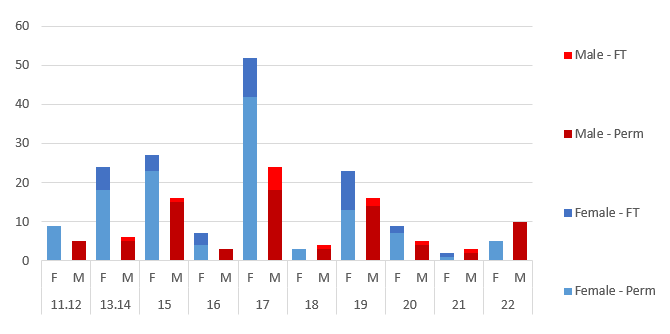
DPMC Demographics - Structure of DPMC by grade

By remuneration review

NZIER analysis identified no statistically different application of the performance or remuneration results by gender, 3rd year in a row.

By employee type

By employee type
Employment Type MEAN Total REM
Male Female % Gap
Permanent $129,781 $113,341 12.67
Fixed Term $142,649 $120,575 15.47
Total $131,658 $114,815 12.79

Men in fixed-term roles are on average in higher grades and paid more than women.

By same/similar roles

DPMC met Equal Pay milestone in 2019 (where sufficient roles to compare).

By employee type
Grade Role cluster #female #male #n GPG
13.14 Support 17 1 0 -3.75%
15 Analyst/advisor 12 15 1 -6.97%
17 Senior analyst/advisor 49 22 0 -0.93%
19 Principal advisor 15 14 0 -6.80%

By Pay Band

Of the 10 pay bands below T2 roles 7 have a GPG positive to women.
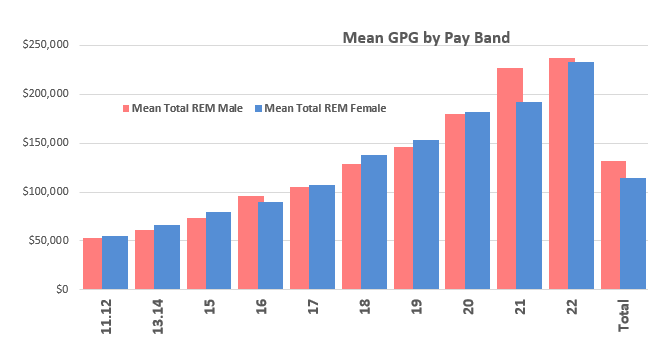
By Pay Band - DPMC Gender Pay Gap Action Plan 2020

Gender balanced leadership

Women occupied 58% of all people manager roles (28 of 49) and 48% of T2 and T3.
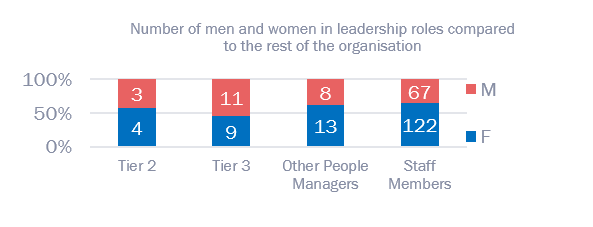
Gender balanced leadership - DPMC Gender Pay Gap Action Plan 2020

Recruitment, progression and turnover#

Recruitment - More women on average apply to roles than men. Overall more women short-listed, interviewed, offered roles and appointed than men – except roles grade 20 and above, in which less women were appointed in 2019, 1 woman to 7 men.
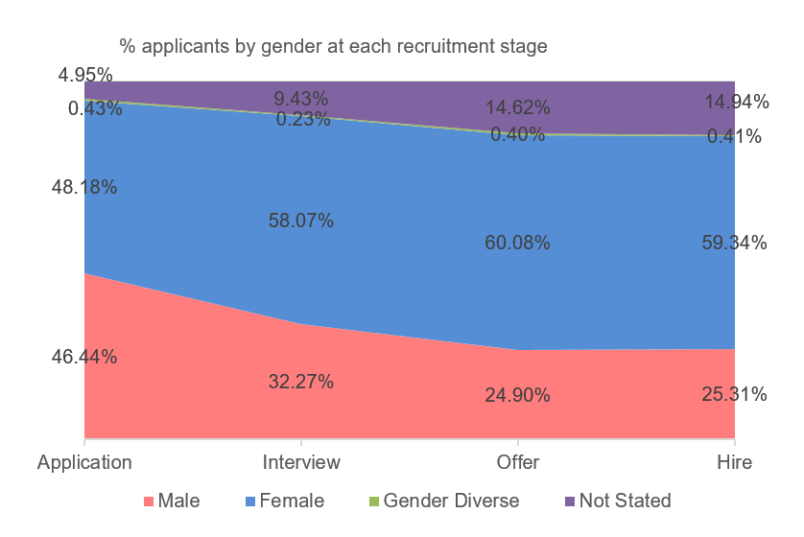
Applicants by gender at each recruitment stage - DPMC Gender Pay Gap Action Plan 2020
  • More male applicants in higher grades and for NSG roles
  • % of female applicants into leadership roles drops to 36% and in NSG to 24% (55 of 233)
  • % of female applicants hired across leadership roles is 71% (23 of 32)

Promotions from graduate analyst to analyst and from analyst to senior appear proportionate with those ready to be considered.  Evidence show that staff (M and F) are not being retained through the analyst/advisor pipeline.

Higher representation of women identified as high potentials.

Women are offered development opportunities at a no less rate than men.

More high performing women leave DPMC (people leaders and non-people leaders) than their high performing male counterparts – exit information indicate go to promotion opportunities or career change.  As a small department there are less senior role opportunities.

No internal appointees to the T2 and T3 roles (M/F) in last two years.  Only one woman to seven men appointed in 2019 in grade 20 and above.

Staff engagement

There is no statistical difference in our engagement score (Kōrero Mai) - 66% for women compared to 64% for men.

Part-time permanent staff have a lower engagement score (54%) and were less ‘happy’ working in DPMC in both the 2018 and 2019. This group makes up 10% of staff and is predominantly female (31 staff, 25 women, 6 men).

Turnover - In 2019 81 staff exited DPMC, 57 (70%) were women. The proportion of women in DPMC is 63%.  72% of the leavers (41 of 57) had less than 3 years’ service, for the equivalent male cohort this was 67% (16 of 24).

Impact of recruitment and turnover – 1 July - 31 December 2019 

Impact of recruitment and turnover – 1 July - 31 December 2019
  Starter # Ave rem Exit # Ave Rem
Women 21 $107,000 31 $103,000
Men 12 $163,000 8 $108,000
GPG 30 June 2019 Mean 7.61
GPG 31 Dec 2019 Mean 12.79

What does our data tell us?#

  • DPMC’s pay gap is driven by a structural issue. Under representation of women in some higher pay grades drives the unadjusted pay gap.
  • DPMC is a small agency where changes in staffing can cause data volatility within grades and across the organisation. For example see earlier table on impact of starters and exits between July and December 2019 which shifted GPG up from 7.61% to 12.79%.
  • Staff progression through the leadership pipeline or the analyst/advisor pipelines may be less effective than expected indicating that we may be able to improve how mechanisms designed to support this operate (e.g. succession planning, career pathways and promotion/ progression). Additionally the data may be impacted by the fixed term nature of many roles and retention. 
  • National Security Group (NSG) does not look to be attracting female applicants as effectively as the rest of DPMC.
  • The impact of fixed term staff (20%) on the data is not well understood.
  • Part-time staff have lower engagement scores, we need to understand this.

Our focus for 2020 and 2021:#

  • Establish career pathways with promotion/progression for analyst/advisor pipeline to support movement through the pipeline and retention of women in grade 15 (NSG and NEMA).
  • Develop and implement succession planning to address retention of high potential women.
  • Work with NSG to understand the recruitment data and develop plan to attract more diverse applicants in recruitment process.
  • Engage with part-time staff to understand what would improve the workplace for this group. 
  • Implement GPG comparator tool and GPG recruitment ‘checkpoints’ into SnapHire for managers to consider gender during recruitment and on appointment.
  • Further work to understand:
    • Retention data
    • Impact of fixed term staff on gender data
  • Continue:
    • Growing DPMC’s inclusive culture
    • Implementation of flexible work by default

Action taken in 2019 against our plan#

Our GPG plan is focused on what is required for DPMC and NEMA to close their gender pay gaps, it also aligns with the broader requirements for all agencies set out by SSC.

Gender balanced leadership#

  • DPMC committed to a principle of a gender balance in senior leadership (T1-3) roles of 40% minimum of female and male, with the remaining 20% flexible. Achieved.
  • Commenced a New People Leader Development Programme to build a balanced pipeline of leaders.

Equal Pay#

  • In 2019 DPMC met the milestone for Equal Pay.  An individual analysis across same or similar roles was completed, with DPMC comfortable that differences were explainable.  This analysis was in addition to the review undertaken by managers and the moderation by ELT as part of the remuneration review and the statistical analysis undertaken by NZIER.
  • A significant part of meeting the Equal Pay Milestone was having no gender pay gaps within same or similar roles (where there are enough roles to compare) for the support role: G13.14; analyst/ advisor: G15; senior analyst/advisor: G17; and principal analyst G19. 
  • The NZIER review across all grades (a proxy for same or similar) identified some grades for further review where there were outliers – these were considered and were explainable by length of service, performance, or the skills sought for a fixed term role.
  • Completed and implemented the review of Government House remuneration ensuring there were no bias in the roles.

Flexible work by default#

  • Joined the SSC pilot group for flex by default.
  • Progressed discussions on working flexibly, developed a new draft policy and guidelines.  Covid-19 lockdown has shown us we can do it. DPMC will now incorporate what we have learned to support managers and staff operate in the new ways of working.

There is no bias or discrimination in remuneration systems and HR practices#

  • Inserted step into the remuneration review so managers could see the impact on gender pay of proposed increase.
  • Used a split matrix[1] to shift low paid workforce – DPMC has a high number of women in lower grades.
  • Engaged NZIER to assess the GPG within roles as well as across the Department after the remuneration review (3rd consecutive year).
  • Coming before end of June – a GPG comparator tool so managers can consider comparison when making appointments.

[1] Our split matrix approach is designed to enable DPMC to achieve faster movement for those in the lower grades.  By having higher percentage movement for the lower grades (compared to less movement in the higher grades) DPMC can to move those staff in the lower grades, who are meeting DPMC expectations, more quickly through the range, thus reducing the gap between the low and higher waged staff.

Ethnicity Data #

DPMC has not been able to analyse ethnicity data as the pool is too small and the recording of data is imperfect.  From 258 staff, 24 identified with an ethnicity other than European and 39 did not disclose.  DPMC is currently working to improve recording the recording of the ethnicity data.

Other#

  • Values and behaviours and the development of a more inclusive culture, linking performance with agreed Performer Expectations.
  • Implemented a Domestic Violence Support Policy and processes.
  • Quality conversations - all managers and staff will be offered development in the 2019 Quality Conversations programme.
  • Review of promotion rounds – not done yet – now 2020.
  • Work with permanent part-time staff to understand their perspective – not done yet – now 2020.
  • Previous
  • Next
Sidebar anchor
View all on one page
Show content paged
Print this publication

Table of Contents

  1. DPMC 2020/21 Gender Pay Agency Action Plan
    1. DPMC/NEMA Data Summary as at 1 Jan 2020
  2. Recruitment, progression and turnover
  3. What does our data tell us?
  4. Our focus for 2020 and 2021:
  5. Action taken in 2019 against our plan
    1. Gender balanced leadership
    2. Equal Pay
    3. Flexible work by default
    4. There is no bias or discrimination in remuneration systems and HR practices
    5. Ethnicity Data 
    6. Other

Related publications

A guide to policy sprints: How to run a successful sprint team

Resources
27 Feb 2026

A guide for panels assessing policy advice papers with the Policy Quality Framework

Resources
22 Sep 2025

Writing for Ministers and Cabinet

Resources
5 Sep 2025

Start Right Guide

Resources
1 Sep 2025

Developing slides for policy advice

Resources
19 Aug 2025

Policy Quality Framework

Resources
30 Jul 2025
View all publications

Content wrapper

Help us improve DPMC

Your feedback is very important in helping us improve the DPMC website.


More menu anchor
Home Department of the Prime Minister and Cabinet (DPMC)
Page url

Toitū carbon reduce ISO 14064-1 organisation

Back to top

About DPMC
  • Who we are
  • Our work
  • Our history
  • Careers
Our business units
  • Cabinet Office
  • National Security and Resilience Group
  • Policy Advisory Group
  • Delivery Unit
  • Corporate
  • Government House
Our programmes
  • New Zealand Royal Honours
  • The Policy Project
  • Government Targets
  • National security
  • Other work
  • Risk and resilience
Publications
  • Publications
  • News and notices
  • Annual reports
  • CabGuide
  • Cabinet Manual
  • Contact us
  • Copyright and licensing
  • Privacy
  • About this site
  • Disclaimer
  • Site map

© Copyright Department of the Prime Minister and Cabinet.

New Zealand Government