
Formats
Introduction#
This Handbook provides a broad overview of the National Resilience System and contains the central government arrangements used to respond to strategic crises, replacing the 2016 National Security System Handbook. It is intended to clarify roles and responsibilities across the system and strengthen agency readiness to respond.
It is divided into three parts.
Part 1. The National Resilience System
Part 2. New Zealand's strategic crisis response arrangements
This Handbook is intended for use by New Zealand government officials who are part of the National Resilience System, and who participate in ODESC system activations for emerging risks, or in response to crisis events. It is intended to be a living document and will be updated annually.
This version has been revised from the May 2025 Handbook to contain a new Foreword, updates on governance arrangements, and roles and expectations for strategic coordination agencies and lead agencies. It also incorporates some minor factual changes reflecting current practice.
Deputy Chief Executive’s foreword#
Strengthening New Zealand’s resilience to National Risks has never been more important. The nature and range of challenges we face mean we must continue to work together, operating according to clearly defined roles and responsibilities, so that when the worst happens, we can be our most effective.
Building and strengthening national resilience means managing National Risks effectively while ensuring we are taking a strategic view—looking over the horizon to consider how those risks will impact the safety, security and prosperity of New Zealanders the most, and taking action accordingly. Providing effective government coordination, advice and strong leadership is essential.
The structures, decisions and investment choices we make in ‘peacetime’ impact how effective our nation will be when facing the next crisis. Risk and opportunity are two sides of the same coin, and we need to improve how we identify opportunities and actions to strengthen resilience. By proactively reducing risk and building resilience to future crises ahead of time we enhance the safety of New Zealanders while also safeguarding our fiscal position and reassuring global markets and investors, which are essential conditions for economic growth.
The National Resilience System must be responsive to these issues, and to new and emerging risks. Agencies need to be clear on their roles and responsibilities and understand how they can work together.
This Handbook explains the National Resilience System and how it enables proactive management of National Risks. It provides a guide to prepare for and navigate through the next crisis. It serves to ensure we are clear about our national risk management objectives, how our system works, who is responsible for what in and out of crisis, with the ability to pivot or refocus our finite resources when required. We know we need to adapt faster, and our system needs to be more responsive.
This Handbook is updated regularly in the face of change to ensure we remain cohesive and effective in how we build national resilience together.

Jeremy Clarke-Watson
Deputy Chief Executive
National Security and Resilience Group,
Department of the Prime Minister and Cabinet
Te Tari o te Pirimia me te Komiti Matua
Part 1. New Zealand’s National Resilience System#
One of the most important responsibilities for government is to build resilience to ensure the prosperity, security, safety, and territorial integrity of New Zealand. Discharging these responsibilities requires systemic arrangements which are well‑led, strategically focused, coordinated, cost‑effective, accountable, and adaptive to any challenges that arise.
The National Resilience System provides the framing through which government agencies work together to proactively manage and build resilience to our most serious hazards and national security threats.
This Handbook provides an overview of the National Resilience System, including the various sub-systems that comprise it. It also includes a detailed outline of New Zealand’s strategic crisis response arrangements, known as the Officials’ Committee for Domestic and External Security Coordination (the ODESC system).
Building resilience together#
The world is experiencing rapid and significant global shifts, driving profound change and heightened uncertainty. New Zealand faces many increasingly complex National Risks – risks arising from serious hazards and national security threats - that could trigger a national level crisis at any time and cause significant harm to our collective safety, security and prosperity.
We must make targeted decisions that position our finite resources to build a more resilient country that not only withstands and recovers from a wide range of potential hazards and threats, but gets ahead of them and emerges stronger and more capable.
Our National Risks are identified in New Zealand’s National Risk Register (appendix 1), ranging from communicable disease outbreaks to critical infrastructure failure to major threats to Pacific security and resilience. We cannot always predict when, where and how these National Risks might play out, or what the scale of their impact will be for New Zealand. Government agencies must ensure we are proactively building New Zealand’s resilience to National Risks – preventing them where we can, reducing their likelihood, consequences and cost where we cannot, and having plans in place so we can respond quickly and effectively when a risk materialises.
No government agency or entity can do this alone – this is a collective effort, and we must take a system approach. By considering the various connections between National Risks and the interdependencies across different government sectors, we can identify gaps and opportunities to leverage our collective capability and capacity, and make strategic and targeted decisions that position our finite resources to where they will have greatest impact. Government agencies work together to achieve this through the National Resilience System.
National Resilience System architecture#
New Zealand has taken some form of holistic and integrated system approach to managing strategic risks since 1987, when the Government established the Domestic and External Security Coordination framework as the foundation of national security governance and planning.
From the outset, this whole‑of‑government approach has focused on ensuring there are arrangements in place to:
- support strategic decision making at ministerial level;
- bring together information for ministers;
- coordinate analysis and assessment;
- develop and test options for whole‑of‑government risk mitigation and crisis response;
- ensure plans are in place; and
- manage national resources and strategic crisis response activities.
There have been changes over time, but subsequent Cabinet decisions have ensured our system approach continues to be explicitly taken on an ‘all‑hazards, all‑threats’ basis.
The architecture used for the management and governance of National Risks, including strategic crisis management, was previously known as the National Security System, as per the ‘all‑hazards, all‑threats’ definition of national security agreed by Cabinet in 2001. Cabinet decided in 2022‑2023 that the National Security System needed a tighter focus on proactively protecting New Zealand from threats to our national security interests in a fundamentally more challenging security environment. This has led to a more tightly focused national security community (or system) that is responsible for managing a set of core issues in New Zealand’s National Security Strategy 2023-2028. In 2024, we therefore rescoped and renamed the system architecture looking across all hazards and threats as the ‘National Resilience System’. This ensures we break down silos and work cohesively to manage National Risks through a simple, agile and cohesive system with clear roles, accountabilities and responsibilities, in both peacetime and in crisis.
Table 1 shows a snapshot of these changes.
TABLE 1. Snapshot of system change
| Term | Old Definition | New Definition |
|---|---|---|
| National security | The condition which permits the citizens of a state to go about their daily business confidently free from fear and able to make the most of opportunities to advance their way of life. All-hazards, all-threats scope. | Using all tools of statecraft to protect and advance New Zealand’s interests in a more challenging strategic environment. Malicious threat scope: Protecting New Zealand from threats that would do us harm. |
| National Security System | Used to refer to the framework used to coordinate and govern national security hazards, threats and risks, for business-as-usual governance and strategic crisis management and associated boards for governance outside of crises. | The community of national security agencies that deliver the key intelligence, policy, and/or operational functions that contribute to New Zealand’s national security. This is guided by the National Security Strategy 2023-28. |
| ODESC system | Synonymous with the National Security System (above). | The all-hazards, all-threats strategic crisis response coordination and governance arrangements. |
| National Risk Approach | Focused on the identification and management of nationally significant risks. Focused on 42 all-hazards all-threats risks across five domains: environmental, social, technological, economic, and security. The approach utilises the 4Rs framework: reduction, readiness, response, and recovery. | Superseded by National Risk and Resilience Framework – see below. |
| National Risk and Resilience Framework | N/A | The national-level framework led by DPMC and agreed by Cabinet, that drives action, supports prioritisation and alignment, and provides assurance across National Risks, to make sure government is taking a proactive and strategic approach to be a more resilient and ready National Resilience System. |
| National Hazards System | Synonymous with the National Security System (above). | Proactive management of National Risks focusing on national hazards. |
| National Resilience System | N/A | Comprises the various systems (national security, hazards, strategic crisis, and emergency management) that function collectively to improve resilience to our most serious hazards and threats across the ‘4Rs’ of Reduction, Readiness, Response, and Recovery. |
As shown in Figure 1, the National Resilience System comprises the various systems (national security, hazards, strategic crisis management and emergency management) that need to function collectively to improve resilience to our most serious hazards and threats, under the strategic leadership and stewardship of the Department of the Prime Minister and Cabinet.
- The National Security System provides proactive management of threats (including some National Risks) as part of an overall approach to protecting and advancing New Zealand’s national security interests. This is guided by the 2023-2028 National Security Strategy and its ‘act early’ principle of the core issues framework, and led by the Department of the Prime Minister and Cabinet; more information can be found in the National Security Strategy and in appendix 2.
- The Hazards Systems provide proactive management of National Risks related to hazards across various systems (including biosecurity, health, and natural hazards). The systems reduce risk and build resilience to these National Risks through upstream policy interventions and reform programmes.
- The Officials’ Committee for Domestic and External Security Coordination (the ODESC system) provides strategic crisis management, coordination and governance for crises arising from all hazards and threats and is led by the Department of the Prime Minister and Cabinet (see part 2).
- The Emergency Management System builds resilience to emergencies through the Civil Defence Emergency Management Act 2002 (CDEM Act). The CDEM Act:
- gives various functions, duties, and powers to statutory officers, government departments, local authorities, emergency services, and lifeline utilities;
- requires planning documents that set out how emergency management works at the local and national levels (across the 4Rs of reduction, readiness, response and recovery), aligned to a national strategy;
- enables more detailed requirements or expectations to be set through regulations and guidance documents;
- provides extraordinary powers that can be used to protect people and limit the consequences of an emergency.
Leadership of the Emergency Management System
The Emergency Management System is led by the National Emergency Management Agency (NEMA), which supports the Director of CDEM and the Minister for Emergency Management and Recovery to carry out their functions and powers under the CDEM Act.
These functions and powers include advising the Minister for Emergency Management and Recovery, monitoring the performance of those with responsibilities under the CDEM Act, issuing guidance and standards, advising on and assisting planning, and directing and controlling resources during a national state of emergency or national transition period.
NEMA fulfils this role by working as a steward, operator and assurer of the Emergency Management System.
More information on this system can be found here at civildefence.govt.nz.
Figure 1. National resilience System

National risk management objectives#
In 2011, Cabinet agreed to the following key objectives to manage risks from hazards and threats in and out of crisis. These remain fit for purpose for guiding strategic national risk and crisis management in the National Resilience System today.[1]
- Ensuring public safety – providing for, and mitigating risks to, the safety of citizens and communities (all hazards and threats, whether natural or man-made).
- Preserving sovereignty and territorial integrity – protecting the physical security of citizens, and exercising control over territory consistent with national sovereignty.
- Protecting lines of communication – these are both physical and virtual and allow New Zealand to communicate, trade and engage globally.
- Strengthening international order to promote security – contributing to the development of a rules-based international system, and engaging in targeted interventions offshore to protect New Zealand’s interests.
- Sustaining economic prosperity – maintaining and advancing the economic wellbeing of individuals, families, businesses and communities.
- Maintaining democratic institutions and national values – preventing activities aimed at undermining or overturning government institutions, principles and values that underpin New Zealand society.
- Protecting the natural environment – contributing to the preservation and stewardship of New Zealand’s natural and physical environment.
Central government agencies are principally responsible for building New Zealand’s resilience and achieving these objectives. This is due to a combination of their primary responsibility for international relations, its ability to direct civil and military assets, the technical and operational capacity and capability at its disposal, its ability to legislate or appropriate substantial funding with urgency, as well as its ability to direct the coordination of activity when necessary.
This central government role involves an agency, or a group of agencies, protecting New Zealand through the delivery of core, business‑as‑usual services (such as border management and protection services delivered by the Ministry of Business, Innovation and Employment, Ministry for Primary Industries, New Zealand Customs Service, the Aviation Security Service, and New Zealand Police). In other situations, it involves multiple agencies acting together to respond to an emerging threat (such as violent extremism) or in response to an emergency or crisis (such as a major earthquake).
In all cases, it involves maintaining and investing in institutional risk reduction, readiness, response and recovery capabilities that are integrated and aligned across agencies and operational and strategic levels. This includes working with local government, the private sector, iwi, Māori, communities and individuals to ensure all aspects of society take responsibility and contribute toward meeting the national risk management objectives.
National Risk and Resilience Framework#
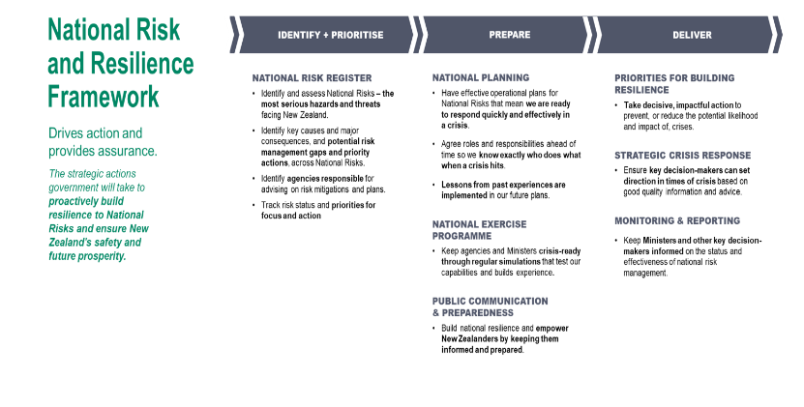
The National Resilience System is guided by the National Risk and Resilience Framework (the Framework), agreed by Cabinet in December 2024[2]. The Framework, led by the Department of the Prime Minister and Cabinet, is used to drive action and provide assurance to key decision makers (Ministers and senior government officials) that National Risks are being actively managed, and that significant gaps, or opportunities to build resilience, are being identified and acted on.
The Framework and New Zealand’s approach is grounded in basic risk management and reflects best practice as it:
- aligns with the OECD Recommendation of the Council on the Governance of Critical Risks;
- aligns with International Risk Management Standard ISO 31000:2018 - Risk Management Guidelines;
- is standard practice amongst New Zealand’s partners and counterparts.
As shown in Figure 2, the Framework outlines the key strategic actions that will be taken across the system to proactively build resilience to National Risks.
The Framework is designed to be complementary to other agency strategies, frameworks and programmes that contribute to resilience‑building of National Risks, including the National Security Strategy, the Adaptation Framework, and a range of other relevant policy programmes and legislative reforms.
Figure 2. The National Risk and Resilience Framework
System leadership: Role of the Department of the Prime Minister and Cabinet (DPMC) for the National Resilience System
DPMC has a mandated role as steward and overall lead of the National Resilience System, and is responsible for[3]:
- focusing on New Zealand’s resilience, risks to this, and integration across the National Resilience System;
- ensuring the National Resilience System works effectively as a system;
- leading, driving and implementing the Framework across government, including through chairing the National Resilience Board and National Security Board;
- assigning agency roles for the management of National Risks, national security core issues, emergencies and crisis events;
- driving implementation of the National Security Strategy and use of the ‘act early’ principle of the core issues framework, across the National Security System;
- prioritising and providing assurance to Ministers and key decision‑makers;
- delivering readiness activities such as the National Exercise Programme and strategic risk identification processes; and
- leading a coordinated government response to an emerging risk or crisis through activation of the ODESC system.
Agency roles under the National Risk and Resilience Framework
Government agencies are responsible for participating in the activities listed in the Framework. Agencies help to reduce risk and increase New Zealand’s resilience by delivering on their responsibilities set out in the Framework, and in accordance with their own legislation and responsibilities. Agencies must:
- ensure risks are being managed effectively;
- support prioritisation and decision making at the Ministerial level;
- inform the Prime Minister’s annual report back on the status and effectiveness of National Risk management and resilience building.
Prior to 2025, there were four distinct but overlapping roles for agencies to perform within the National Resilience System:
- Strategic coordinating agencies - assigned to convene and integrate across government to build a strategic, whole‑of‑system approach to each national security core issue, as laid out in the National Security Strategy.
- Risk-coordinating agencies – assigned to each National Risk, responsible for working with DPMC to provide coordinated cross‑agency advice on strategic risk management gaps or opportunities, through the activities outlined in the Framework.
- Lead agencies for emergencies - expected to have the capacity and capability to fulfil their responsibilities under emergency management legislation for the operational response to emergencies. In this context, an ‘emergency’ has a specific legal definition under the Civil Defence Emergency Management Act 2002 (CDEM Act) [4]
- Lead agencies for crisis response in the ODESC system - a broader set of lead agencies who were responsible for managing responses to crises that meet the thresholds described in Part 2 of this Handbook (noting that not all strategic crises meet the legal definition of emergency).
In September 2025 Cabinet agreed to strengthen and streamline accountabilities for central government organisations by shifting to two clear and distinct roles, to be assigned by DPMC in consultation with agencies [ECO-25-MIN-0143].
These roles are:
- Strategic Coordination Agency (SCA) – responsible for leading and coordinating the whole-of-government strategic approach to a particular National Risk or national security core issue; and
- Lead agency - responsible for preparing for and managing the response to an emergency or crisis event at the national level.
A list of Strategic Coordination Agencies and Lead agencies can be found in appendices 1 and 2 respectively.
Strategic coordination roles are assigned to National Risks (and core issues), while lead agencies are assigned to specific potential crisis or emergency events that may arise. Because National Risks are generally scoped more broadly, and can play out in a variety of different ways, there will not always be a corresponding pre-determined lead agency for response. Instead, the lead agency will depend on the nature of the specific crisis or emergency event that manifests.
Strategic Coordination Agency roles
Strategic Coordination Agencies are responsible for leading and coordinating a whole-of-government strategic approach to a particular National Risk or national security core issue.
This includes:
- Working with DPMC and other agencies to deliver relevant activities and meet expectations outlined under the National Risk and Resilience Framework, including providing regular reporting to DPMC on the status and effectiveness of relevant national risk management efforts.
- Leading and coordinating a cross-agency strategic approach by convening and connecting agencies that have relevant policy, analysis or operational functions to design and implement the supporting work programme(s).
- Anticipate: maintaining awareness of emerging issues, key trends or changing conditions that could impact policy, strategy or decision-making relating to the hazard, threat or core issue.
- Prevent and mitigate: identifying (and introducing where possible) measures which build resilience, deter or prevent risks from occurring, or reduce their potential impacts.
- Proactively identifying and escalating gaps, risks or improvement opportunities to other agencies, DPMC, relevant governance boards (i.e. National Security Board / Natural Hazards Risk Reduction Forum / National Emergency Management Board / National Resilience Board, as outlined in Figure 3), or Ministers as needed.
- Establishing trusted relationships with key stakeholders (domestic and/or international) to support collaboration, alignment and sharing of knowledge.
- Working together with DPMC’s Strategic Crisis Management Directorate and lead agencies to ensure that a strategic risk management approach is taken in readiness for National Risks that may result in a crisis or emergency. This includes developing knowledge of strategic risks that may arise through a deliberate identification process as well as exercising, either through agency-led exercises or in the National Exercise Programme.
- Considering how to incorporate the role of Strategic Coordination Agency into business continuity arrangements.
The National Exercise Programme
The aim of the National Exercise Programme (NEP) is to strengthen strategic readiness for effective decision making and strategic risk management during crisis events.
Recognised as a critical preparedness function within the National Risk and Resilience Framework, the NEP is supported by the ODESC system’s architecture, which ensures that key decision-makers can provide clear direction during crisis, based on good quality information and advice. The ODESC system NEP activities have a strategic focus on:
- Enhancing understanding of strategic risks that may arise which supports better decision-making during real-life events.
- Strengthening longer-term planning and risk management by identifying lessons and issues for system improvement.
- Strengthening agencies’ understanding of the expectations for roles and responsibilities during an ODESC system activation.
- Reducing financial burdens for agencies to design and deliver exercises in line with their own financial imperatives and operational priorities.
- Maintaining flexibility in the schedule for adding new exercises as new threats or hazards arise.
DPMC delivers the NEP through annual simulated activations of the ODESC system. Alongside this, lead agencies maintain their own readiness programmes, including national and inter-agency exercises for specific hazards and threats, under Section 105 of the National Civil Defence Emergency Management Plan Order 2015. DPMC can participate in these agency-led exercises to support and identify strategic risks for future response planning.
Following NEP activities, DPMC gathers observations and lessons identified through agency feedback and surveys, identifying what worked well and areas for improvement. Findings from agency feedback are compiled into ODESC system post-exercise reports, which are shared widely across participating agencies to inform future crisis planning.
Lead agency roles
Part 2 of this Handbook sets out further details of the lead agency role, including responsibilities, expectations and helpful guidance.
Governance of the National Resilience System
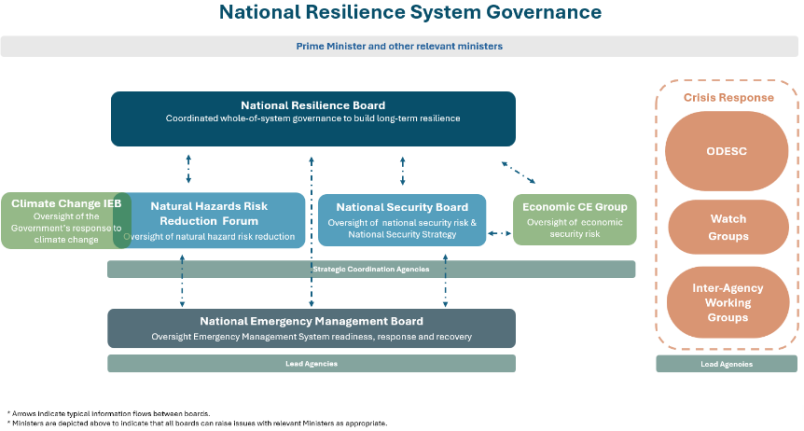
Key to an effective National Resilience System is having appropriate oversight and governance in place. The Chief Executive-level governance structure is shown in Figure 3.
As part of the wider system restructure, in 2025 Cabinet agreed[5] to several changes, including:
- Establishing a National Resilience Board chaired by the Chief Executive of DPMC to provide coordinated whole-of-system governance for the National Resilience System, with a strategic focus on building long-term resilience.
- Disestablishing the National Hazards Board.
- Directing the Ministry for the Environment to work with DPMC to establish appropriate governance arrangements focused on natural hazard risk reduction [which led to the establishment of the Natural Hazards Risk Reduction Forum in March 2026].
Each board has a clear mandate which collectively provides governance across the system.
National Resilience Board
The National Resilience Board looks across the entire National Resilience System, driving coherence and ensuring government’s national resilience efforts are aligned and strategic.
The National Resilience Board delivers on its purpose by:
- Setting strategic direction and providing oversight of the National Resilience System to ensure work across government is aligned around common priorities for national resilience.
- Addressing complex system issues, looking across agency and portfolio boundaries to draw connections, deliberate on trade-offs, and identify future-focused opportunities to build resilience.
- Providing advice and assurance to Ministers on the National Resilience System including system-level priorities, sequencing and potential trade-offs to strengthen New Zealand’s resilience.
National Security Board (NSB)
The National Security Board leads the national security community to deliver on the whole‑of‑society national security vision, set out in the National Security Strategy.
The National Security Board’s three key objectives are to:
- collectively provide assurance and advice to government;
- advance a strategic approach across national security;
- govern and enable an integrated and high‑performing system.
The Board’s responsibilities include governing core national security issues of the National Security Strategy, and overseeing the cross-system management of national security National Risks, escalating issues to Ministers as appropriate.
Natural Hazards Risk Reduction Forum (NHRRF)
The Natural Hazards Risk Reduction Forum was established by the Ministry for the Environment in March 2026 to deliver a whole-of-government approach to the proactive management of natural hazard National Risks with a focus on risk reduction. The Forum’s secretariat is hosted by the Ministry of Cities, Environment, Regions and Transport (MCERT).
To make use of existing governance structures, and to recognise the crossover in membership the Forum convenes after Climate Change Chief Executives Board (CCIEB) meetings, following adaptation-related agenda items.
National Emergency Management Board (NEMB)
In addition to the Cabinet-agreed changes noted above, as part of wider governance reform NEMA disestablished the Emergency Services Leadership Board and established a National Emergency Management Board. The Board provides strategic leadership, coordination and assurance for the Emergency Management System, within the National Resilience System.
Economic Chief Executives Group
The Economic Chief Executives Group oversees the Government’s economic security work programme under the National Security Strategy. This sits within the Group’s wider role as a senior cross-agency forum on issues affecting New Zealand’s medium-to long-term economic performance, including the Government’s Going for Growth work programme.
These Chief Executive-level forums are supported by a number of sub‑committees across the National Resilience System, such as the Maritime Security Oversight Committee, the Counter‑Terrorism Coordination Committee, the Major Events Security Committee, and the Incident Management Reference Group. These sub‑committees are chaired by representatives from agencies with technical expertise and the ability to coordinate work programmes based on topic.
Figure 3. National Resilience System governance boards
Notes
- [1] DES Min (11) 1/1. Current strategies, including the National Security Strategy and the National Disaster Resilience Strategy, provide more granular interests and objectives which contribute to these overarching goals.
- [2] CBC-24-MIN-0112.
- [3] CBC-24-MIN-0112.
- [4] National Civil Defence Emergency Management Plan Order 2015, Appendix 1
- [5] ECO-25-MIN-0143 refers
Part 2. New Zealand’s Strategic Crisis Response Arrangements#
New Zealand has been using a system approach to provide coordinated whole‑of‑government strategic crisis response since 1987. The Officials’ Committee for Domestic and External Security Coordination (the ODESC system) sits within the National Resilience System and uses the basic structures and administrative arrangements established as part of the original 1987 framework, refined through subsequent Cabinet decisions and the lessons learned from nearly 30 years of crisis response.
The ODESC system provides the mechanism for government agencies to come together quickly and flexibly in times of strategic crisis, to ensure that:
- agencies’ activities are coordinated;
- strategic risks are being identified and managed;
- the crisis response is timely and appropriate;
- national resources are applied effectively and efficiently;
- adverse outcomes are minimised;
- multiple objectives and priorities are dealt with together; and
- lessons are identified and used to shape our actions in the future.
In 2011, Cabinet confirmed that the role of central government is to provide leadership in crisis conditions. Central government is also expected to:
- ensure that potential, imminent or actual disturbances to the usual functioning of society and the economy, or interruptions to critical supplies or service, cause minimum impact; and
- achieve a swift return to usual societal functions.[6]
The ODESC system supports central government in proactively performing these key roles. It provides oversight and governance during significant crises or security events (agnostic of threat or hazard), where consequences of national significance warrant the coordination of all‑of‑government planning and prioritisation.[7] Strategic crisis management is included as a function within the National Risk and Resilience Framework; the supporting architecture of the ODESC system ensures key decision‑makers can set direction in times of crisis based on good quality information and advice.
The national risk management objectives (part 1) provide enduring direction for all responses, making sure actions are always aligned with the overall strategic goals and do not become solely about the specific needs of each situation.
The ODESC system is not intended to override existing statutory powers and responsibilities of Ministers and departments. This principle remains in place today.
The role of the Department of the Prime Minister and Cabinet#
The Chief Executive, DPMC, is the agency head of the ODESC system. They are responsible for ensuring that strategic direction is set for crisis management and that the Prime Minister and Ministers receive advice and assurance about crisis situations as they arise and progress.
The Deputy Chief Executive of the National Security and Resilience Group, DPMC, ensures that the system architecture:
- performs as intended and that decisions of the ODESC system are implemented;
- is proactive and alert to current events, and scans for possible future events requiring an ODESC system response;
- activates the ODESC system, when necessary;
- ensures that experience is retained as knowledge within the system by helping agencies implement lessons identified in system debriefs.
DPMC’s Strategic Crisis Management Directorate (SCMD) provides stewardship and secretariat support for the ODESC system architecture, and is often the first port of call for agencies concerned about emerging risks. A SCMD member is on call 24/7 to be alerted to emerging and actual crisis situations.
SCMD’s responsibilities include:
- providing thought leadership to guide the ODESC system through considering issues and identifying risks both before and during crisis events;
- working with Strategic Coordination Agencies and lead agencies to support readiness through deliberate strategic risk identification processes and through delivery of the National Exercise Programme;
- convening the right level of meetings and ensuring decisions are being taken at the right level (escalating decision‑making, as needed);
- supporting the Prime Minister and the Chairs of each tier of ODESC system meetings to enable them to take well‑informed and timely decisions; and
- conducting ODESC system debriefs once a response is deactivated and following completion of National Exercise Programme activities, which engenders an ODESC system culture of continuous improvement and enhances agencies’ readiness.
Other DPMC teams may be involved in strategic crisis management, including Strategic Communications, the National Security Policy and Coordination Directorate (NSPC), the National Assessments Bureau (NAB), and the National Risk and Resilience Directorate (NRRD).
- The Strategic Communications team provides high level oversight and issues management when the ODESC system is activated. It looks at what is happening across agencies, communities and the media in an event or emergency to provide advice and manage risks and opportunities.
- NSPC and NRRD provide briefing and decision support to the Chief Executive of DPMC and/or the Chairs of each tier of ODESC system, as well as policy advice and support to the Prime Minister and Ministers, as needed.
- NAB is New Zealand’s central, all-source assessments agency. As per its responsibilities under the Intelligence and Security Act of 2017, NAB provides independent and impartial assessments on events and developments relevant to New Zealand's national security and international relations, which can be used to inform government decision-making during a crisis.
- When ODESC system activations identify longer-term strategic risk management issues that may require appropriate risk assessment and mitigation, NRRD can work with SCMD to ensure these are factored into appropriate workstreams and activities under the National Risk and Resilience Framework.
The lead agency model for strategic crisis and emergency response#
The concept of lead agencies for strategic crisis management was endorsed by Cabinet in 2011 and has been a concept in practice since at least 2001.[8]
The principal reasons for having nominated lead agencies to maintain readiness for, and respond to, strategic crises, are to:
- ensure clarity and certainty about responsibilities and leadership at time of crisis;
- ensure responsibilities for horizon scanning, and risk mitigation are assigned properly (during a crisis or emergency);
- give early warning, and more time for decision‑making;
- facilitate prompt response, and thereby avoid compounding damage;
- give clarity on communications lines, and the provision of necessary information;
- ensure structures and coordination are in place before crises occur; and
- have designated responsibilities for both proactive and reactive risk management.
The lead agency concept is based on the principle that incidents, emergencies and crises will be handled first at the lowest level possible, escalating when needed. In many cases, incidents can be managed within the resources of a single department, or at a local level. If incidents or emergencies require the support or involvement of multiple agencies, or are more serious or complex, wider whole‑of‑government response systems are used.
Lead agency assignments
As described in Part 1 of this Handbook, DPMC was given the responsibility in 2025 to assign lead agency roles. These roles are given to agencies responsible for preparing for and managing the response to an emergency or crisis event at the national level. The current listing can be found in appendix 2.
Given that the lead agency model function relates to the management of crises and emergencies at the strategic and national level, and applying Crown resources to do so, lead agencies appointed by DPMC are all central government organisations (including some Crown Entities).
DPMC uses a set of guiding principles and criteria to confirm that allocations of lead agencies remain fit-for-purpose and reflect agency mandates, responsibilities and legislation. This includes assignment for new or emerging crisis events outside of ODESC system activations. Criteria for assigning lead agencies includes:
- Expertise: the agency must have the expertise, authority and experience to manage the crisis.
- Legislation: the agency must be authorised by legislation or have the primary mandate for managing the response to a particular threat or hazard, supported by appropriate legislative frameworks and structures.
- Relationships: key stakeholder relations and partnerships that make an agency the best-placed to lead.
- Levers: the agency may hold other levers in addition to, or in the absence of, legislative frameworks that can be used to influence outcomes such as policy or regulations.
When a hazard or threat event meets the specific legal definition under the Civil Defence Emergency Management Act 2002 (CDEM Act) [9], lead agencies in the Emergency Management System are expected to have the capacity and capability to fulfil their responsibilities under emergency management legislation for the operational response to emergencies. In this context, an emergency:
- “is the result of any happening, whether natural or otherwise[10]; and
- causes or may cause loss of life or injury or illness or distress or in any way endangers the safety of the public or property in New Zealand or any part of New Zealand; and
- cannot be dealt with by emergency services, or otherwise requires a significant and coordinated response under the CDEM Act.”
States of national emergency
Most emergencies as defined under the CDEM Act 2002 are managed at the local government level through regional CDEM Groups, with central government support coordinated by the National Emergency Management Agency (NEMA).
If it appears that an emergency cannot be managed effectively by the affected CDEM Groups, the Minister for Emergency Management and Recovery may declare a state of national emergency.
During a state of national emergency, the Director of CDEM (a statutory officer appointed by the Chief Executive of NEMA) becomes responsible for directing and controlling resources that are made available for emergency management and gains access to various emergency powers, such as the power to require evacuations, close roads, or requisition resources. In practice, these functions and powers are generally delegated to the National Controller. The emergency management roles and responsibilities of agencies at the national level are described in the National CDEM Plan Order 2015.
Declaring a state of national emergency does not automatically require activation of the ODESC system. However, in some events (e.g. the 23 February 2011 Christchurch earthquake, the COVID‑19 pandemic, and Cyclone Gabrielle) the ODESC system was required because of the strategic and national nature of the event. Local emergencies may also trigger the ODESC system, for example if they create novel consequences that do not have a clear owner.
Some agencies have separate powers or declaration processes available under their own legislation, which can be used to deal with situations that do not meet the definition of ‘emergency’ in the CDEM Act. For example, the powers in the Biosecurity Act 1993, Epidemic Preparedness Act 2006, and the Water Services Act 2021.
These powers may be needed even when a state of emergency is declared under the CDEM Act. For example, the initial response to the COVID‑19 pandemic led to both a state of national emergency and an epidemic notice being in force at the same time.
Practically, experience has shown us that all government agencies should consider themselves as potential lead agencies and should plan and prepare accordingly. The reason for this approach has been derived from experience that there is potential for any agency to become a lead agency for a crisis at any time. For example, if they are the victim of a cyber‑attack requiring an ODESC system response, as was demonstrated in the attack against the Reserve Bank of New Zealand in 2020/2021.
There will also be occasions when agencies find themselves in the position of lead agency for an emerging hazard or threat for which a lead has not been assigned, because their statutory accountabilities and stakeholder relationships make them best‑placed to lead. This was the case during the carbon dioxide shortages in 2023/2024 when the Ministry of Business, Innovation and Employment agreed to take on the lead role.
Reserve Bank of New Zealand cyber event (2020/2021)
In December 2020, a cyber actor compromised a file transfer tool used by many organisations globally, including the Reserve Bank of New Zealand (RBNZ). Sensitive RBNZ files were obtained illegally prior to the RBNZ becoming aware of the vulnerability on 7 January 2021 and promptly applying a patch to mitigate risks.
After RBNZ advised SCMD’s 24/7 on call officer about the breach, a collective decision was made to activate the ODESC system. The implications of a cyber breach on New Zealand’s central financial institution met the ODESC system trigger of has unusual features of scale, nature, intensity, or consequence.
Five Watch Groups convened between 11 and 21 January 2021. ODESC was not required to meet, and neither was an Inter‑Agency Working Group. Key risks discussed included concerns the information could be used for malicious purposes leading to physical and personal security being compromised or financial advantage, as well as maintaining trust and confidence domestically and internationally, in RBNZ and associated financial institutions.
The RBNZ was the lead agency responding to the incident, as it was their system that was compromised. They were closely supported by the National Cyber Security Centre as well as New Zealand Police, the Department of the Prime Minister and Cabinet, the Department of Internal Affairs, the Financial Markets Authority, the National Emergency Management Agency, the Treasury, and the Ministry of Foreign Affairs and Trade.
This activation highlighted that in an increasingly complex operating environment, any agency may become relevant to the ODESC system, in either a lead or support role
Flexibility is a key component of the ODESC system, given the extremely complex scope of New Zealand hazardscape, threats and risks that may cut across a range of agencies and sectors. There is not always a clear lead agency to manage an emerging situation or crisis event that meets the threshold for ODESC system activation. When this is the case, ODESC system agencies can make a deliberate, collective decision about which agency is best placed to take on the lead agency role, as happened during the response to the Auckland fuel pipeline disruption in 2017. In some cases, the lead role may transition from one agency to another as the crisis situation evolves.
In highly complex large‑scale crises, a key role for the ODESC system is to identify when the lead agency model may not be fit-for-purpose and collectively agree to change the model. Alternatively, situations may arise in which the Chair ODESC requests an agency to take the lead role or determines that another model may be required.
The system can also be used to ensure appropriate support is provided when the agency that is best placed to lead does not have a structure in place and can collaboratively agree which agency should take the role of lead when there is no pre‐designated lead agency. This often occurs during ODESC system meetings, where agencies work together to identify capability or capacity gaps in an agency’s ability to lead the response, and work together to determine how best to support the lead agency.
Auckland fuel pipeline rupture (2017, no lead agency)
In September 2017, the pipeline which brings diesel, petrol and aviation fuel into Auckland from Marsden Point Oil Refinery ruptured leading to 10 days of supply disruptions. This resulted in fuel rationing as well as cancelled flights.
Operationally, this was an industry‑led response as the pipeline was privately owned. However, the consequences of the rupture meant that all‑of‑government strategic crisis management was needed and therefore the ODESC system was activated. The triggers for activation were unusual features of scale, nature, intensity or consequence, and there was no lead agency.
Five Watch Groups and four ODESCs were held for this response. The Ministry for Business, Innovation and Employment (MBIE) were confirmed as the lead agency, supporting the Minister of Energy and Resources, and liaising with industry. MBIE was supported by other agencies, whose involvement was strategically managed, by ODESC:
- New Zealand Defence Force provided drivers to help transport aviation fuel from Marsden Point to Auckland, and made available the HMNZS Endeavour, to carry diesel.
- The Ministry of Transport led in person engagement with the fuel suppliers, Auckland Airport, and the airlines, to establish and maintain a common operating picture, whilst MBIE led the frequent online engagement.
- MBIE and New Zealand Customs Service ensured that travellers in transit and air crew would not be caught out by visa requirements they had not anticipated.
- The Ministry of Transport, New Zealand Transport Authority, and Police worked with Auckland Council to map out tanker routes through the city, and to ensure that fuel deliveries could continue outside normal hours.
- The National Emergency Management Agency (NEMA - then known as MCDEM) supported the response in the National Crisis Management Centre, with a facility manager and staff with response, planning and public information expertise. Had they been required, NEMA would have been able to exercise powers available under the Civil Defence Emergency Management Act 2002.
Support agencies#
Agencies supporting the lead agency are required to develop and maintain capability and capacity to ensure that they can perform their role. It should be noted that support agencies may have statutory responsibilities and/or specific objectives of their own, which they may need to pursue in addition to, or as part of, the support that they provide to the lead agency during crisis management.
Escalated decision‑making and governance in the ODESC system#
When responding to strategic crises, government uses the national risk management objectives (in part 1) as the primary response objectives, although bespoke objectives will be developed as well.
To achieve these goals, the ODESC system uses the same type of three‑tiered escalating decision‑making and governance model as used for strategic risk management described in part 1 and shown in Figure 4. The Prime Minister is the lead decision‐maker in the ODESC system, although in practice crisis events are usually able to be managed and coordinated before they need to escalate to the Prime Minister or Ministers for decisions.[11]
Figure 4. Escalated decision-making during crisis response
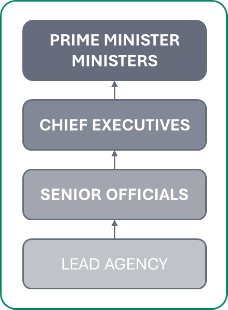
This three‐tiered decision‑making model is used in support of lead agencies, and provides an architecture which allows the ODESC system to provide advice and assurance to the Prime Minister and Ministers, that:
- emerging and current national hazards and national security threats and risks are being accurately identified and managed;
- direct and indirect consequences at strategic and operational levels are being sufficiently identified and managed and agencies’ activities are coordinated;
- appropriate resources are available;
- gaps in capability are considered and dealt with in a structured and coordinated way; and
- information is flowing in a timely and accurate way to allow effective decisions to be taken at the right level.
These arrangements also take into account the need to communicate with the public in a consistent way.
There is no longer a standing Cabinet committee associated with the ODESC system for crisis management (based on political decisions taken over time about how the Cabinet committee structure is used), and how Ministers come together is based on the event at the time. Depending on the size, scope, nature of the event, the Prime Minister may ask full Cabinet to meet; a bespoke Committee may be formed (as was done following the 2011 Canterbury earthquake and for the Covid‑19 response); or select Ministers may be given ‘powers to act’ – it is the Prime Minister’s discretion to decide which Ministers should be involved.
Supporting Ministers in a crisis
In national security and hazard events, particularly if there is a significant and/or imminent threat, it is crucial that timely and well‑informed support is provided to the Prime Minister and other responsible Ministers. The principles which guide the support to Ministers include:
- Agencies should look to avoid surprises: brief early and update regularly. When the ODESC system is activated, this includes ensuring that there is a clear lead Minister and the lead agency provides a ‘single source of truth’ so that communications can be aligned.
- Lines of communication between individual Ministers and their departments will be maintained and operate as they usually do.
- DPMC and the Chair of ODESC will liaise with the Prime Minister and the Prime Minister’s office.
Officials must support Ministers during a crisis in such a way as to enable them to fulfil their leadership function, as system leaders but also their own statutory responsibilities. Regular updates keep Ministers appropriately informed of progress and ensures they have accurate and timely information needed for decision‑making. Updates also provide assurance to Ministers that the situation is being well‑managed, that risks have been identified and mitigated, and appropriate communications arrangements are in place.
The ODESC system in practice
Escalated decision‑making and strategic risk management during crisis are practically accomplished through a set of administrative arrangements using three tiers of meetings that focus on national interest at the strategic level (shown in Figure 5). When considering what level of meeting should occur, who should attend and what decisions may be needed, the national risk management objectives will be considered. Using these objectives helps ensure that the system is not captured by the immediate needs of the crisis, but can focus on the higher-order risks, such as risks to New Zealand’s reputation.
Figure 5. Levels of ODESC meetings
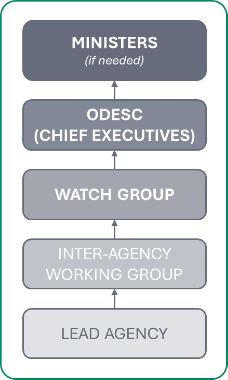
ODESC is a flexible grouping of Chief Executives who meet to provide strategic direction on matters of strategic crisis.[12] There is no standing membership for ODESC meetings; agencies are involved relevant to the situation at the time. ODESC is chaired by the Chief Executive of DPMC, or their delegated DPMC representative.[13] ODESC members operate as a collective to:
- apply their collective judgement and experience to assess the high‑level strategic implications of the issue and agreeing on response options;
- agree to the prioritisation of resources when required;
- provides strategic advice on priorities and the mitigation of strategic risks beyond the lead agency’s control;
- support Ministerial decision‑making by providing advice on strategic crisis matters related to relevant portfolios.
Watch Groups sit below ODESC and are comprised of Tier 2 senior officials who can bring their level of judgement and expertise to decision-making that may need to be made at Watch Group meetings. Watch Group attendees must be able to commit resources and agree to actions on behalf of their agency.[14]
Watch Groups are usually chaired by the Deputy Chief Executive, National Security and Resilience Group, DPMC, or their delegated DPMC representative. Watch Groups:
- are a tool to enable situational clarity;
- ensure high‑level coordination between agencies occurs in quickly‑developing and/or complex situations;
- identify strategic risks and tests whether appropriate mitigations are in place;
- ensure that systems are in place to enable effective management of complex issues, including communications requirements;
- provide coordinated advice to the Chair of the ODESC via the Watch Group Chair, including whether any escalation is required.
Inter‑Agency Working Groups (IAWGs) are comprised of senior officials from relevant agencies, chaired by the Director, Strategic Crisis Management Directorate, DPMC, or their delegated DPMC representative.
An IAWG may convene prior to activation of the ODESC system and is often used as a tool to determine whether activation is required. They are used to:
- develop initial situational awareness for emerging risks;
- maintain consistent situational awareness for longer duration ODESC system activations;
- consider whether appropriate activities are underway to achieve risk mitigation at the lowest level possible;
- escalate to Watch Group if more senior decision‑making is required.
The ODESC system uses these different levels of meetings to ensure that:
- the response seeks to meet the national risk management objectives;
- there is a consistent understanding of the situation, including threats and risks;
- those threats and risks are being managed appropriately;
- a single source of truth is established for Ministers (and the public if needed);
- the lead agency has the resources it needs (and support agencies as well, particularly during concurrent events);
- triggers for escalation are agreed.
Usual conventions about the roles and responsibilities of Ministers, Chief Executives and senior officials with respect to decision‑making continue to apply. These are set out in the Cabinet Manual and in various pieces of legislation. These should be well understood by ODESC meeting attendees, given the speed at which decisions may be required during a response. Appendix 6 shows the different components of the ODESC system working together in crisis response.
Security clearances – do you need one for ODESC system meetings?
There is no generic requirement for agencies to have a certain level of security clearance to attend an ODESC system meeting. The classification of the meeting depends on the nature of the event that has taken place and whether classified information is being used as part of the response to a particular event.
That said, it is generally expected that agencies have at least one or two individuals cleared to Top Secret so that they can attend senior-level meetings dealing with highly classified material at short notice.
If that is not possible and there are no cleared agency staff available, arrangements can be made to attend at least some parts of the relevant ODESC system meeting. Uncleared attendees will be asked to step out if classified matters are being discussed.
Threshold for central government leadership – activation of the ODESC system
A comprehensive all‑hazards, all‑threats approach is taken when considering what may constitute a strategic crisis and when the strategic crisis management arrangements should be initiated (referred to as ODESC system activation). There is no one single definition used for ‘crisis’ in the New Zealand context; rather, a crisis is an event that meets one or more of the following criteria (collectively referred to as the triggers to consider ODESC system activation for crisis response).
- There are unusual features of scale, nature, intensity or consequence.
- Conveys significant challenges for sovereignty or nationwide law and order.
- Suggests multiple or inter‑related problems – creating national or systemic risk.
- Involves a high degree of uncertainty or complexity.
- Is beyond the ability of one lead agency to manage.
- There is no pre‑defined lead agency.
- Concurrency of events (impacting system resources).
- Is an emerging issue that might meet the above criteria in the future, and would benefit from proactive management.
As an emerging or actual crisis occurs and depending on the scale/nature of the situations, agencies are expected to consult with either the Chair ODESC (Chief Executive, DPMC), the Chair Watch Group (Deputy Chief Executive, National Security and Resilience Group) or the Strategic Crisis Management Directorate, at the earliest opportunity to determine whether there is a need to initiate coordination through activation of the ODESC system. Activation occurs in consultation with the lead agency.
Christchurch terrorist attack 2019
The ODESC system activated rapidly in response to the terrorist attacks on Christchurch’s Al Noor Mosque and Linwood Islamic Centre. The activation triggers of unusual features of scale, nature, intensity or consequence; and involves a high degree of uncertainty or complexity were both met.
Within twenty minutes of the first attack, the Police Commissioner had informed the Chair of ODESC who convened Chief Executives for an ODESC meeting three hours later. Police were confirmed as the lead agency and immediately following the meeting, the Police Commissioner, Chair of ODESC, and Director‑General of the New Zealand Security Intelligence Service briefed the Prime Minister.
The ODESC system remained active for three weeks and considered the immediate and longer‑term implications of such a significant event. These included:
- public safety and reassurance (such as protective security arrangements for vulnerable groups, planning and delivering major events, and outreach to social media platforms to remove material of the attack),
- social cohesion,
- support to victims and the families of victims (including the deployment of emergency welfare support, and identifying and overcoming barriers to short and long‑term assistance such as financial and immigration matters),
- the criminal investigation and the coronial process (ensuring proper process while also respecting cultural and religious needs),
- international reputation and messaging (reassurance that New Zealand is safe, as well as mobilising international support and solidarity).
Many of ODESC’s strategic risk considerations had been anticipated by the existing counter‑terrorism work programme; highlighting the value in exercising and strategic planning. Strategic communications played a significant role in this activation as well.
Over the course of the activation, ODESC met on eight occasions, and Watch Group convened 14 times. The composition of ODESC increased from 14 Chief Executives at the first meeting to 18 a few days later reflecting the widening of considerations as the response progressed.
For example, whilst the Police remained the lead agency, the Department of Internal Affairs assumed the lead for the 29 March National Remembrance Service.
The needs of the victims and their families were paramount throughout the response.
Tropical cyclones Judy and Kevin
In 2023 the ODESC system activated to consider what support options New Zealand could provide Vanuatu following the landfall of tropical cyclones Judy and Kevin. International humanitarian assistance and disaster relief (HADR) does not necessarily trigger ODESC system activation but on this occasion, New Zealand was also responding domestically to Cyclone Gabrielle ‑ concurrent events impacting system resources.
The purpose of the Watch Group was to collectively consider competing priorities in the wider context, ensuring that support to Vanuatu was provided without diminishing the capability and capacity of agencies to support the domestic response to Cyclone Gabrielle. Additional risks discussed included: public perception and the need for good communications and messaging; welfare of personnel responding to concurrent events; geo‑strategic considerations; and the support needs of Vanuatu’s citizens in New Zealand.
MFAT as the lead agency for HADR worked closely with NEMA, the lead agency for the Cyclone Gabrielle response, and other key support agencies to develop a suite of appropriate and possible options, as well as messaging that conveyed that support provided to Vanuatu would not undermine the response efforts within New Zealand.
The ODESC system deactivated one month later with only one Watch Group convened, and no other ODESC system meetings took place.
Roles and expectations for lead agencies in crisis and emergency response
For events that meet the threshold for a crisis within the ODESC system, lead agencies are expected to lead any operational response required for an ODESC system activation (noting that some crises do not have an operational component) in accordance with their statutory roles and responsibilities to manage incidents and emergencies. In ODESC system activations, lead agencies are expected to also perform the system‑level roles for a lead agency currently codified in the National Civil Defence Emergency Management Plan Order 2015. Lead agencies at the national level are expected to:
- monitor and assess the situation;
- plan for and coordinate the national response;
- report to the ODESC and provide policy advice; and
- coordinate the dissemination of public information.
For emergencies, lead agencies are also responsible for meeting the requirements in the CDEM legislative framework related to readiness and response.
Table 2 depicts some distinction between strategic and operational components of an ODESC response.
Table 2. Lead Agency roles in a response
| Lead Agency roles in a response | System Relating to all the component elements working together as parts of an interconnecting whole | Hazard-/threat-specific Relating to the individual elements that relate to the lead agency’s areas of expertise & mandate |
|---|---|---|
| Strategic Relating to the identification of long-term or overall aims and interests and the means of achieving them | Focus: Long-term All of Government, ‘NZ Inc’ | Focus: Long-term Hazard-specific |
| Operational Relating to specific and short term aims − usable in everyday time and asset allocation | Focus: Daily/Weekly All of Government Incident Response | Focus: Daily/Weekly, Hazard-specific |
Activation of the ODESC system does not take away responsibilities from the lead agency in its response to a national hazard or national security threat event. Rather, the activation is intended to support the lead agency, including the provision of support to coordinate risk management activities that may be outside of the lead agency’s mandate. Decisions taken within the ODESC system at any level do not override the statutory responsibilities of agencies in their operational lead capacity.
The lead agency is also responsible for delivering any technical risk management of the response due to its specialist capability for the particular hazard/threat.
Intersection of the ODESC system and the Coordinated Incident Management System
New Zealand’s Coordinated Incident Management System (CIMS) establishes a framework of consistent principles, structures, functions, processes and terminology for response and the transition to recovery. It enables agencies to plan for, train and conduct responses in a consistent manner, without being prescriptive. CIMS relates to the operational management of a response; the ODESC structure sits above this if the situation has met the threshold to require coordinated strategic response at the national level.
National Controllers will be expected to support their ODESC system meeting attendees and may be invited to brief Watch Group and ODESC meetings in support of their principals.
Depending on the nature of the event, the crisis may have wider and longer‑term consequences than those which have more immediate impacts and can be quickly resolved. The lead agency is expected to continue to coordinate across workstreams required to address these consequences until a business‑as‑usual state can be achieved. This does not mean that the lead agency is responsible for conducting all of the work in the workstreams – it is not responsible for “doing all of the doing”. It is responsible for coordinating those workstreams - for ensuring that other agencies’ activities remained joined up to ensure that government can make informed decisions and take action for consequence management from a holistic perspective.
When activated, the role of the ODESC system is to provide governance and coordination at the strategic level, and to provide assurance to the Prime Minister and Ministers. The expectation is that lead agencies (and all agencies working together in the response) will continue to perform their statutorily mandated operational activities as required throughout the duration of the response.
Helpful guidance for lead agencies
The following provides guidance for lead agencies to follow before a crisis event occurs and during an ODESC system activation, in addition to any operational requirements that may be needed. They have been developed based on observations and lessons identified from more than 20 years of ODESC system response, as elements that contribute to a successful strategic crisis response.
Before a crisis occurs, lead agencies should:
- Work with DPMC and other agencies to deliver relevant activities and meet expectations outlined in the National Risk and Resilience Framework and National Resilience System Handbook including:
- Ensuring appropriate response plans and frameworks are in place and exercised ahead of time, in accordance with any guidance or requirements issued by DPMC;
- Ensuring structures and coordination mechanisms are in place before crises occur;
- Ensuring agency internal response plans and internal coordination mechanisms include specific functions, roles and responsibilities for strategic risk management against the national risk management objectives.
- Work with DPMC’s Strategic Crisis Management Directorate and the relevant Strategic Coordination Agency to conduct a strategic risk estimate process to ensure there is consistent understanding of what strategic risks may arise as a result of, and in response to, a hazard or threat event;
- Ensure that workstreams needed for strategic risk mitigation and agency coordination are identified, as well as identifying the key contacts for those workstreams;
- Work with the workstream leaders to ensure they have plans in place to perform their workstream leadership roles during a crisis event, and to build their understanding of how they would fit into the lead agency’s response;
- Partner with assigned Strategic Coordination Agencies to develop shared information, ensure alignment and that roles and responsibilities are understood; and
- Consider how to incorporate the role of lead agency into business continuity management arrangements.
During a crisis response, experience shows that agencies are better placed to perform the strategic functions outlined in the National Civil Defence Emergency Plan Order 2015 if they:[15]
- Integrate policy, strategic communications, and legal staff into the crisis response from the outset;
- Identify and capture strategic risks to response objectives by reviewing existing strategic risk estimates in the context of the response, or carrying out a bespoke strategic risk estimate process if no work has been done previously.
- Ensure that workstreams are identified and underway to ensure better coordination and mitigate risks where possible (or escalate for discussion in an ODESC system meeting if needed);
- Coordinate across the workstreams to ensure supporting agencies are not working in siloes;
- Undertake all of society consequence management planning from the beginning (end-to-end planning);
- Establish a strategic information coordination function, to ensure that the right information requirements are developed and disseminated in a coordinated way to those agencies that collect and assess;
- Put mechanisms in place to share information and intelligence with ODESC system agencies in a deliberate and agreed way;
- Notify DPMC as quickly as possible if they are unable to fulfil obligations required for the response so that this may be considered at the appropriate level of ODESC system meeting; and
- Identify and capture lessons from the beginning of the response, to enable continuous improvement throughout the response and to feed into ODESC system debrief following deactivation.
These are not formal requirements, nor are these lists exhaustive, but they seek to highlight some of the key activities that can lead to an effective crisis response. In particular, the important roles that coordination of assessed information, policy advice and strategic communications in support of decision-making and Ministerial alignment cannot be overestimated.
The importance of information in a crisis
A common understanding of good information is essential in a crisis. It supports early identification of risks, provides insight into possible mitigations and allows agencies to act early. Decision‑makers are able to set the strategic direction for the response based on the best available information to them. Good decisions are based on relevant, accurate, and up‑to‑date information, it assists decision‑makers to consider what the implications of the situation might be, and where it may lead, enabling them to set response objectives and priorities.
This information can be obtained from a variety of sources including but not limited to:
- advice from the Watch Group or Inter‑Agency Working Group;
- intelligence assessments;
- scientific advice;
- advice from other specialist or technical groups.
It is common for information in the early stages of a response to be partial, and assumptions may need to be made. It is important to manage expectations around this, to avoid delays in decisions that may need to be made while a complete picture of the situation is being developed.
Policy roles in a crisis event
It is important that agencies’ policy teams are involved early on in a crisis. They may be called upon to provide advice on current policy positions, develop crisis‑specific policy advice, or be required to develop significant policy options (including legislative review or new appropriations) following the event.
Full and properly coordinated cross‑agency engagement will ensure that Ministers and ODESC receive the best policy advice – free, frank, and full – during and after the crisis.
Some crises will require significant policy coordination. It is helpful if the lead agency brings together a Policy Coordination Group to coordinate policy development, if policy work is needed, during a crisis. This should be attended by policy leads from the lead agency and other relevant agencies. To enable this to occur quickly, it is important for agencies to develop relationships ahead of time. In support of this, agencies should include policy teams in readiness exercises to establish clarity of roles and responsibilities, and to foster good collaboration.
DPMC’s National Security Policy and Coordination Directorate (NSPC) can assist the lead agency with policy coordination, if required. For example, in the immediate days after the terrorist attacks on 15 March 2019, DPMC’s then National Security Policy Directorate convened a Policy Coordination Group to canvass the policy and legislative implications from the attacks, across a range of sectors. By developing a policy tracker that was regularly updated, this group ensured there was visibility in one place of individual agencies’ advice going to Ministers across the system, and highlighted priority actions for the Prime Minister, Ministers and ODESC.
Communications roles in a crisis event
Public communications play a critical role during and following a crisis event, and in helping the public and communities to recover.
All communications should:
- proactively provide information so there is confidence in the response and recovery;
- provide advice to the public on what to do or what not to do; and
- manage public expectations.
We do this by ensuring all stakeholders have appropriate, accurate and timely information; this includes those directly affected, Ministers, media, communities, and the public.
Many crisis events require both a public information management function and a strategic communications approach. These need to work closely together – further information can be found in appendix 7. If the event involves multiple agencies, it is important to ensure that their respective communications teams agree who will take the lead on developing public communications early in the response. It will usually be the lead agency who will be expected to maintain close coordination throughout the response to ensure coherent, consistent communications across the full gamut of agencies’ various responsibilities.
Deactivation of the ODESC system
It is impossible to tell from the outset of an ODESC activation what the duration of the activation will be. Typically, deactivation will occur when there is consensus amongst those participating in the response that any residual activity or recovery can be managed within agencies’ business-as-usual processes; and appropriate recovery structures are in place (which may be bespoke based on ODESC system agreement and political decisions). The decision to deactivate will be recorded in the appropriate ODESC system meeting minutes, and DPMC will send notification to relevant agencies (via email) that the ODESC system has been deactivated.
Continuous improvement
Following deactivation, agencies are expected to organise internal and external operational debriefs as part of their own continuous improvement and lessons management process to improve readiness. Depending on the scale and nature of the activation, DPMC will organise an ODESC system‑level debrief, to reflect on what worked well and what could be improved. Findings from the ODESC system debrief will be distributed as widely as possible across agencies to inform thinking and planning for any future crisis event. DPMC will also ensure that lessons related to longer‑term systemic risks are fed into the Strategic Coordination Agencies for consideration and action, including escalation into the National Resilience System governance boards when needed.
Notes
- [6] DES Min (11) 1/1, DES Min (11) 1.
- [7] National Civil Defence Emergency Management Plan Order in Council 2015, section 13
- [8] POL Min (01) 33/18, DES Min (11) 1/1.
- [9] National Civil Defence Plan Order in Council 2015, Appendix 1
- [10] This includes, without limitation, any explosion, earthquake, eruption, tsunami, land movement, flood, storm, tornado, cyclone, serious fire, leakage or spillage of any dangerous gas or substance, technological failure, infestation, plague, epidemic, failure of or disruption to an emergency service or a lifeline utility, or actual or imminent attack or warlike act.
- [11] A role card for the role of Ministers can be found in appendix 3.
- [12] A role card for ODESC attendees can be found in appendix 4.
- [13] National CDEM Plan Order in Council 2015, section 13(4)(b).
- [14] A role card for Watch Group attendees can be found in appendix 5.
- [15] Not all elements will be required for each activation, but consideration should be given as to which elements apply at the beginning of any activation.
PART 3. Appendices#
Appendix 1. Strategic Coordination Agencies for National Risks and National Security Core Issues#
As of 1 July 2026, DPMC has assigned the following agencies as Strategic Coordination Agencies for particular National Risks and national security core issues, as outlined in the National Security Strategy.
| National risks (and associated national security core issues) | Strategic coordination agency(ies) |
|---|---|
| Earthquake | Ministry of Cities, Environment, Regions and Transport (MCERT) |
| Tsunami | MCERT |
| Volcanic activity | MCERT |
| Severe weather and flooding | MCERT |
| Space weather event | Ministry of Business, Innovation, and Employment (MBIE) |
| Drought | Ministry for Primary Industries (MPI) |
| Pest or disease incursion | MPI |
| Communicable disease outbreak | Ministry of Health (MoH) |
| Vector borne disease outbreak | MoH |
| Radiological substance incident | MoH |
| Wildfire | Fire and Emergency New Zealand (FENZ) |
| Failure or disruption of a major financial mechanism or institution | Treasury (TSY) |
| Terrorist attack (Terrorism and violent extremism) | Department of the Prime Minister and Cabinet (DPMC) |
| Act of foreign interference or espionage targeting New Zealand (Foreign interference and espionage) | DPMC |
| Technological disruption due to adoption or misuse of emerging, critical and sensitive technologies (Emerging, critical and sensitive technologies) | DPMC |
| Major cyber incident (Cyber security) | DPMC & Government Communications Security Bureau (GCSB) |
| Armed conflict (Strategic competition and the rules-based international system) | Ministry of Defence (MoD) & Ministry of Foreign Affairs and Trade (MFAT) |
| Major threat to Pacific Regional Stability (Pacific resilience and security) | MFAT |
| Deliberate interference, disruption or destruction of space assets, infrastructure or services upon which New Zealand rely (Space security) | New Zealand Defence Force (NZDF), MoD & MBIE |
| (Maritime) mass arrival (Border security) | MBIE & Customs (Customs sole SCA for Border security core issue) |
| Major maritime security incident (Maritime security) | MCERT |
| Transnational and serious organised crime (TSOC) | Police & Customs |
| Violent protest or public disorder event | Police |
| Economic security | TSY |
| Major trade disruption | TSY, MFAT & MPI |
| Significant disruption or failure of Water critical infrastructure | MCERT |
| Significant disruption or failure of Transport critical infrastructure | MCERT |
| Significant disruption or failure of Telecommunications critical infrastructure | MBIE |
| Significant disruption or failure of Energy critical infrastructure | MBIE |
Appendix 2. Lead agencies for strategic crisis and emergency response#
As of 1 July 2026, DPMC has assigned the following agencies as lead agencies for strategic crisis response and emergency response.
| Emergency or crisis event | Lead agency |
|---|---|
| Geological (earthquake, volcanic hazards, landslide, tsunami) | National Emergency Management Agency (NEMA) |
| Meteorological (coastal hazards, coastal erosion, large swells, flooding, severe winds, storm surges, heavy snow) | NEMA |
| Infrastructure failure | NEMA |
| Drought | Ministry for Primary Industries (MPI) |
| Pest and disease incursion | MPI |
| Food safety incident | MPI |
| Infectious human disease outbreak (including pandemic) | Ministry of Health (MoH) |
| Radiation incident | MoH |
| Wildfire | Fire and Emergency New Zealand (FENZ) |
| Urban fire | FENZ |
| Hazardous substance incidents | FENZ |
| Hostage taking overseas | Ministry of Foreign Affairs and Trade (MFAT) |
| Offshore humanitarian response | MFAT |
| Antarctica incident | MFAT |
| Armed conflict overseas (i.e. Russia-Ukraine, Israel-Gaza) | MFAT |
| Terrorist attack (domestic) | New Zealand Police (NZ Police) |
| Violent protest or public disorder event | NZ Police |
| Major transport incident | Ministry for Cities, Environment, Regions and Transport (MCERT) |
| Mass arrival | Ministry of Business, Innovation and Employment |
| Major cyber incident | Affected agency/ies or entity/ies, supported by the National Cyber Security Centre |
| Espionage | New Zealand Security Intelligence Service |
| Major maritime safety incident | Maritime New Zealand (MNZ) |
| Marine oil spill | MNZ |
Appendix 3. Role of Ministers and Ministers’ offices#
Ministers
There is not a standing Cabinet committee associated with the ODESC system for crisis response, and how Ministers come together is based on the event of the time. Depending on the size, scope, and nature of the event, the Prime Minister may ask for full Cabinet to meet; a bespoke committee to be formed; or select Ministers may be given powers to act ‑ it is the Prime Minister’s discretion to decide on which Ministers should be involved.
Depending on the scale of the event, Ministers may have a role in making policy decisions in response to or in recovery from crisis, and this may cross portfolios. This includes briefing Cabinet on the impacts and consequences of the event, and recommending financial assistance for response and recovery activities. Ministers do not have an operational role as part of the crisis response and recovery. The respective roles and responsibilities of Ministers and Chief Executives are outlined in the Cabinet Manual and in various pieces of legislation.
Ministers provide public assurance and information about the government’s level of involvement (any decisions made), as well as reiterating safety messages. Ministers show support for the response operations underway, but generally do not comment on operational issues.
Ministers and their office staff (i.e. political advisors and private secretaries) do not attend ODESC system meetings. Instead, agencies will keep their Minister regularly informed by providing timely and accurate information about the response and recovery.
Chief executives
In addition to directing operational responses of the situation, Chief Executives support Ministers in making decisions by providing timely and accurate information about the response and recovery, including any decisions made that will have implications for central government. They provide public assurance and public safety messages, and might also comment on operational issues.
Appendix 4. ODESC role card#
Purpose
ODESC is responsible for ensuring all‑of‑government coordination, providing overall strategic direction to the lead agency, and ensuring that departments and agencies which are supporting the response and recovery at the operational level are adequately supported. ODESC considers high‑level system risks with strategic implications.
ODESC provides the linkage to the political level and advises the Prime Minister and relevant Ministers on strategic developments, options, and priorities.
ODESC members are Chief Executives and operate as a collective. They focus on the system rather than attending solely as the heads of their respective agencies. ODESC members are expected to make constructive use of the variety of experience and perspectives in the room in debating the issues put before them and coming to a collective view.
ODESC does not override the responsibilities which individual Chief Executives or Ministers have to take decisions in their own areas of concern. Usual conventions about the roles and responsibilities of Chief Executives and Ministers with respect to decision‑making still stand; these are set out in the Cabinet Manual and in various pieces of legislation.
Composition
ODESC is chaired by the Chief Executive of DPMC. The composition of ODESC during a crisis will depend on the characteristics and consequences of the event.
Only invitees are permitted access into the ODESC meeting room. Agency policy advisors or support staff must be kept to a minimum and will only be invited into the ODESC meeting room with the agreement of the Chair, if absolutely required (e.g., if required to brief the meeting).
Briefing your ODESC attendee
It is suggested that ODESC attendees are briefed on the following:
- situation update from both the all‑of‑government and your agency’s perspective including response and recovery activities, along with any supporting information;
- response and recovery arrangements (any pre‑written plan or arrangements) – from both the all‑of‑government aspect and your agency’s specific arrangements;
- your agency’s statutory obligations and its role in response and recovery;
- key points from the Watch Group, including risks and action points;
- any additional significant risks which have been identified by, or pertain to, your agency which need to be drawn to the collective attention of the Chief Executives.
Appendix 5. Watch Group role card#
Purpose
Watch Groups are a tool to obtain situational clarity in what is often a chaotic environment. They are also responsible for ensuring ongoing high‑level coordination between agencies and for ensuring that systems are in place to ensure effective management of complex issues. The Chair of the Watch Group reports on the Watch Group’s assessments and advice to ODESC, if ODESC convenes. The Watch Group Chair also provides the Chair ODESC with an update from each meeting, regardless of whether an ODESC is needed or not.
Watch Groups must focus on the national interest and remain at a strategic level. Watch Group members will be expected to test current arrangements, check with each other to ensure that all risks have been identified and are being managed, identify gaps and areas of outstanding concern, and agree on any further action required.
Particularly during a fast‑moving event, Watch Groups will make some decisions in their own right. Such decisions are usually operational and relate to taking one or another course of action. In general, however, decisions that are irreversible and commit New Zealand to a certain course of action should be escalated to ODESC or Ministers, depending on the scale and significance of the decision.
Composition
Watch Groups are made up of deputy Chief Executives or equivalent level Tier 2 managers who are able to contribute judgement and expertise; commit resources; and agree actions on behalf of their organisation. Invitations are extended to agencies relevant to the situation at hand. Professional disciplines (e.g., legal, economic, communications, science) may also be represented, when required.
The Deputy Chief Executive, National Security and Resilience Group, DPMC, has the formal role of Watch Group Chair. In practice, this may be delegated to the Director, Strategic Crisis Management Directorate (SCMD) DPMC. SCMD sets the time and agenda for the meetings, in consultation with the lead agency.
Prior to attending a Watch Group, all representatives should ensure that they:
- are ready to provide status reports, outline their agency’s response, and contribute advice for collective decision‑making,
- are well versed in their agency’s statutory obligations and its role in response and recovery,
- have a good understanding of the ODESC System arrangements and the response plan(s) for the crisis at hand,
- are familiar with supporting information relating to the crisis, including that distributed during the response.
Pre‑requisites for sound decision making
Watch Groups need the best information available to support decision‑making – acknowledging that, particularly in the early stages of a response, this is likely to be partial. The inputs required by the Watch Group include:
- A Situation Update (lead agency) needs to be comprehensive enough to enable supporting agencies to have a common picture of the incident, but not so detailed as to drag the meeting into the weeds. The update can be presented orally at the meeting. Imagery and mapping, are useful aids to understand the situation through their ability to provide situational awareness, rapid assessment, improved coordination and assist public communication.
- When relevant to the situation, an intelligence assessment should be provided by a strategic intelligence agency or by the National Assessments Bureau. Similarly, information may be provided by a chief science advisor based on the nature of the event.
- What response activities are underway (lead agency). This includes what is being done to address the situation, including key priorities and objectives.
- All agencies should come prepared to raise observations on strategic risks arising from their perspective and what resourcing pressures they may be facing.
Watch Group members have dual roles, representing their agency’s view and also acting as a collective. Attending an ODESC system meeting is an active engagement process. Members are expected to make constructive use of the varying perspectives and experiences in the room in debating the issues and coming to a collective view.
Watch Group Agenda
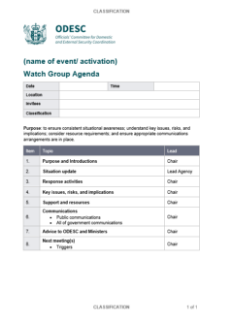
Appendix 6. ODESC system components#
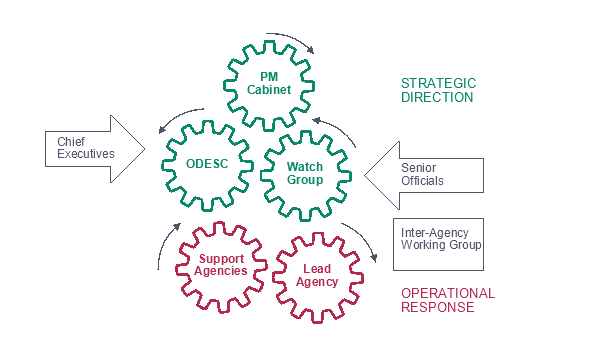
Appendix 7. Communications#
Public information management (PIM)
The lead agency for a response is also responsible for public information management (PIM).
PIM responsibilities include:
- advising and implementing appropriate communications strategies,
- ensuring timely, consistent, and effective messaging for the public,
- liaising and responding to the media,
- monitoring and analysing media reporting and information,
- liaising with other government agencies, private sector entities, local authorities, communities and iwi, as appropriate.
Strategic communications
Having a deliberate approach to strategic communications role ensures there is high level oversight and issues management when the ODESC system is activated. It looks at what is happening across agencies, communities and the media in an event or emergency to provide advice, and manage risk and opportunities.
Strategic communications support Ministerial level public messaging focused on reassurance, de‑escalation, recovery, and social cohesion.
Strategic communications responsibilities include:
- supporting and advising ODESC, Watch Groups and Inter‑Agency Working Groups,
- briefing PMO and Ministers on strategic communications plans, and providing coordinated messaging,
- providing information and advice to Chief Executives and other key stakeholders,
- liaising with the lead agency to ensure alignment across the response and to ensure they have sufficient staff to manage media and public information requirements,
- liaising with other government agencies, private sector entities, local authorities, communities and iwi, as appropriate.
Strategic communications coordination plays a vital role in supporting the overall response. DPMC maintains a pool of experienced communications staff who can lead strategic communications in a complex crisis response. In other events, the lead agency is encouraged to take responsibility for this role, with support available from the DPMC or other agencies involved in the response. Recent examples of effective strategic communications coordination include the North Island Severe Weather Events and the sinking of the HMNZS Manawanui.