
Skip to main content Skip to navigation
Back to top anchor
Home Department of the Prime Minister and Cabinet (DPMC)
Page url
  • Careers
  • Media
  • Contact us
  • Home
Open search Close search
  • Contact us
    • How to make an Official Information Act request
      • Tips for requesting information
      • Guidance on how we will respond
  • About DPMC
    • Who we are
    • Our work
    • Our history
    • Careers
  • Our business units
    • Cabinet Office
      • Roles and responsibilities
        • Statutory and formal responsibilities
      • Supporting the work of the Cabinet
        • Cabinet Committees
        • Elections
        • Cabinet Manual
          • Publication information
          • Foreword
          • Preface
          • Introduction
          • 1. Sovereign, Governor-General, and Executive Council
            • Introduction
            • Sovereign of New Zealand
            • Governor-General
            • Executive Council
            • Clerk of the Executive Council
            • Meetings of Executive Council
            • Gazetting and entry into force
            • Announcement
            • New Zealand Royal Honours System
            • Heraldry
            • Order of Precedence
            • Related Information
          • 2. Ministers of the Crown: Appointment, Role, and Conduct
            • Introduction
            • Prime Minister
            • Deputy Prime Minister
            • Ministers
            • Parliamentary Under-Secretaries
            • Parliamentary Private Secretaries
            • Conduct, public duty, and personal interests
            • Interactions with representatives from non-government or commercial organisations
            • Personal email accounts and phone numbers
            • Gifts and awards
            • Speaking engagements, endorsements, and non-ministerial activities
            • Government advertising and publicity guidelines
            • Ministerial travel
            • Related Information
          • 3. Ministers of the Crown and the Public Sector
            • Introduction
            • The public service and the public sector
            • Ministers and the public service
            • Ministers and Crown entities
            • Ministers and companies in the public sector
            • Integrity and conduct throughout the public sector
            • Related Information
          • 4. Ministers, the Law, and Inquiries
            • Introduction
            • Attorney-General
            • Comment by Ministers on judicial decisions
            • Crown legal business
            • Litigation involving Ministers
            • Legal advice and legal professional privilege
            • Inquiries
            • Related Information
          • 5. Cabinet Decision-making
            • Introduction
            • Cabinet
            • Cabinet committees
            • Principles of Cabinet decision-making
            • Cabinet and Cabinet committee procedures
            • Secretary of the Cabinet and the Cabinet Office
            • Related Information
          • 6. Elections, Transitions, and Government Formation
            • Introduction
            • The electoral cycle
            • Transitions following an election
            • Caretaker convention
            • Government formation
            • Mid-term transitions
            • Early election
            • Provision of information by the state sector during transitions
            • Related Information
          • 7. The Executive, Legislation, and the House
            • Introduction
            • Speech from the Throne
            • Prime Minister's statement
            • Government legislation programme
            • Revision Bills
            • Law Commission work programme
            • Development and approval of bills
            • Secondary legislation
            • Ministers and the House
            • Ministers and select committees
            • Parliamentary treaty examination
            • Crown's financial veto
            • Citizens initiated referenda
            • Declarations of inconsistency
            • Related information
          • 8. Official Information and Public Records
            • Introduction
            • Information held by government
            • Official Information Act 1982
            • Privacy Act 1993
            • Ombudsmen Act 1975
            • Providing information to select committees
            • Production or discovery of official documents
            • Requests for parliamentary information
            • Ministers and Public Records
            • Disclosure and use of official information by former Ministers
            • Convention on access to Cabinet records of a previous administration
            • Related Information
          • Appendix A: The Treaty of Waitangi/Te Tiriti o Waitangi
          • Appendix B: Letters Patent Constituting the Office of Governor-General of New Zealand 1983
          • Index
        • History of the Cabinet Manual
      • Ministers and their portfolios
        • Ministerial List
        • Ministerial portfolios
          • Briefings to incoming ministers (BIMs)
          • Directory of Ministerial portfolios
        • Register of Assigned Legislation
        • Delegations
        • Ministers' interests
          • Ministers' Interests Jul 2025 - Dec 2025
          • Ministers' Interests Jan 2025 - Jun 2025
          • Ministers' Interests May 2024 - Dec 2024
          • Ministers' Interests 2023-2024
          • Ministers' Interests 2022-2023
          • Ministers' Interests 2021-2022
          • Ministers' interests 2020-2021
          • Ministers' Interests 2019-2020
          • Ministers' Interests 2018-2019
          • Ministers' interests 2017-2018
          • Ministers' interests 2016-2017
          • Ministers' interests 2015-2016
          • Ministers' interests 2014-2015
          • Ministers' interests 2013-2014
          • Ministers' interests 2012-2013
      • Executive Council
      • The Honours Unit
    • National Security and Resilience Group
      • National Assessments Bureau
        • Working for the National Assessments Bureau
      • National Risk and Resilience Directorate
      • National Security Policy and Coordination
      • Strategic Crisis Management Directorate
    • Policy Advisory Group
      • Roles and responsibilities
    • Delivery Unit
    • Corporate
    • Government House
  • Our programmes
    • New Zealand Royal Honours
      • Make a nomination
        • Nominations for Honours
        • New Zealand Royal Honours nomination guidelines
        • Nomination Form and Guide to making Nominations
        • Bravery Award Nominations
        • The New Zealand Antarctic Medal: Nomination Guidelines
      • Honours lists and recipients
        • Honours lists
          • Current Members of the Order of New Zealand
          • Knights and Dames of the New Zealand Order of Merit
          • Knights and Dames of the Orders of Chivalry
          • The New Zealand Gallantry Awards
          • The New Zealand Bravery Awards
          • The New Zealand Antarctic Medal
          • The Privy Council
        • Titles and styles of knights and dames
        • Wearing of insignia
          • Order of wear: orders, decorations and medals in New Zealand
          • Method of mounting insignia
      • The New Zealand Royal Honours system
        • Overview of the New Zealand Royal Honours system
        • Forfeiture of Honours
        • History
        • Components of the New Zealand Royal Honours system
          • The Order of New Zealand
          • The New Zealand Order of Merit
          • The King's Service Order
          • Gallantry and Bravery Awards
            • New Zealand Gallantry Awards
            • New Zealand Bravery Awards
          • The New Zealand Antarctic Medal
          • The New Zealand Distinguished Service Decoration
          • Other distinctive New Zealand Honours
          • "The Right Honourable"
            • The Right Honourable in New Zealand
          • "The Honourable"
            • Roll of The Honourables
          • Privy Council
        • Order of Wear
        • Rules relating to the acceptance and wearing of Foreign Honours
        • New Zealand Herald of Arms Extraordinary
      • New Zealand Royal Honours Image Gallery
      • New Zealand Royal Honours FAQs
      • Privacy and AI use statement
    • The Policy Project
      • About the Policy Project
      • Policy quality
      • Policy skills
        • Development Pathways
          • Use the tool
      • Policy capability
      • Policy Tools
        • Start Right
        • Design thinking
          • Journey mapping
          • Role play
          • Prototyping
          • Experience interviews
          • Personas
        • Behavioural insights
          • Behavioural Change Models
        • Community engagement
          • Citizen juries
        • Futures thinking
          • Horizon Scanning
          • Assumption Testing
          • Futures Wheel
          • Scenarios
          • Wind Tunnelling
          • Backcasting
        • Treaty of Waitangi analysis
      • Long-term Insights Briefings
      • Policy advice themes
        • Engagement
        • Evidence and evaluation
        • Free and frank advice
        • Innovation
        • Policy and law
        • Stewardship
      • Policy community
        • Policy system leadership
        • Policy agencies
        • Policy managers
        • Policy practitioners
        • Ways to connect to the policy community
        • Open government
      • Agency panels and quality reporting
      • Publications
      • Policy community events
    • Government Targets
      • Government Targets Quarterly Reports
    • National security
      • New Zealand's National Security Strategy
        • New Zealand’s national security community
      • National Security Intelligence Priorities
      • Counter-terrorism
        • New Zealand's Countering Terrorism and Violent Extremism Strategy
        • Preventing and Countering Violent Extremism Fund
        • Preventing and Countering Violent Extremism Research
        • Terrorist and National Security Event Media Protocols
      • Countering foreign interference
      • Critical Infrastructure
        • Critical Infrastructure Resilience
      • Cyber Security Strategy
        • Cyber ransom advice
        • United Nations Cybercrime Treaty
          • We asked, you said, we did
      • Intelligence and Security Act 2017
        • 2022 Review of the Intelligence and Security Act 2017
        • Why did we need new legislation?
        • What is intelligence?
        • Defining national security
        • Bringing the agencies further into the public service
        • Powers and warrants
          • Activities allowed under intelligence warrants
          • The authorisation framework
          • Protections for New Zealanders
        • Strengthening oversight of NZSIS and GCSB
        • Whistleblowing and protecting classified information
        • Cover and immunities
          • Cover and assumed identity arrangements
          • Immunities from legal liabilities
        • Sharing information
          • Domestic information sharing
          • Arrangements with foreign partners
        • The National Assessments Bureau
        • Case studies
          • Counter-terrorism
          • Investigating a suspected terrorist
          • Counter-espionage
          • Cyber security in action
        • Resources
      • Strengthening resilience to disinformation
        • Multi-Stakeholder Group to strengthen resilience to disinformation
        • Fund for community-based initiatives to strengthen Aotearoa’s resilience to disinformation
        • Public Research and Insights into Disinformation
      • National Security Long-term Insights Briefing
        • LTIB Topic Consultation Summary
      • Royal Commission of Inquiry into the terrorist attack on Christchurch masjidain
        • The Government’s Response
        • Working with Communities - get involved
          • Kāpuia - Ministerial Advisory Group Nominations
        • Response Steering Group
        • Response Progress
        • Measuring Success
        • Improving Community Engagement
        • Key Documents
        • Get in touch
      • Five Country Ministerial
    • Other work
      • Prime Minister's Chief Science Advisor
        • Meet Dr John Roche, Prime Minister's Chief Science Advisor
        • Prime Minister's Chief Science Advisor archives
          • Archive
            • Professor Sir Peter Gluckman 2009-2011
            • Professor Sir Peter Gluckman 2011-2013
            • Professor Sir Peter Gluckman 2013-2015
            • Professor Sir Peter Gluckman 2015-2018
            • Professor Dame Juliet Gerrard 2018-2021
            • Professor Dame Juliet Gerrard 2021-2024
      • Chief Science Advisor Forum
      • Severe Weather Events Recovery Review Panel releases
      • Historical Programmes
        • NEMA
        • Cyclone Recovery Unit
          • Cyclone Recovery Funds and Schemes for people in Affected Regions
          • Publicly released Cyclone Recovery-related documents
        • He Whenua Taurikura
          • He Whenua Taurikura Hui
            • He Whenua Taurikura Hui 2021
            • He Whenua Taurikura Hui 2022
          • Master’s Scholarship
            • Master's Scholarship 2021/2022
            • Master's Scholarship FAQs
          • He Whenua Taurikura Co-Directors
        • Greater Christchurch recovery and regeneration
          • Greater Christchurch Group
            • Roles and responsibilities
              • Disestablishment of CERA
            • External websites
          • The Greater Christchurch Regeneration Act 2016
          • Our regeneration partners
          • Global Settlement Agreement with Christchurch City Council
          • Recovery and regeneration plans
            • Cranford Regeneration Plan
            • Ōtākaro Avon River Corridor Regeneration Plan
            • Lyttelton Port Recovery Plan
            • Residential Red Zone Offer Recovery Plan
            • Land Use Recovery Plan
            • Christchurch Central Recovery Plan
          • Section 71 proposals
            • Commercial film or video production facilities in Christchurch – Section 71 Proposal
            • Hagley Oval
            • Lyttelton Commercial Zone Parking
            • Yaldhurst Recreation and Sports Facility
            • Residential Unit Overlay District Plan Changes
            • Redcliffs School relocation
          • Christ Church Cathedral Reinstatement Project
          • Past Orders in Council
        • COVID-19 Proactive Releases
        • Kāpuia – Ministerial Advisory Group
          • Advice from Kāpuia
          • Kāpuia feedback to agencies
          • Kāpuia Pānui
        • All of Government COVID-19 Royal Commission of Inquiry
        • Child Wellbeing and Poverty Reduction
          • Child Wellbeing and Poverty Reduction Group
          • Child and youth wellbeing strategy
            • Publications and resources
          • Reducing child poverty
            • Formal gazetting of targets for reducing child poverty
        • COVID-19 Group
        • Health Transition Unit
        • Implementation Unit
          • Latest news and updates
        • Inquiry into the EQC
        • Connect Smart
        • Canterbury Earthquake Recovery Learning and Legacy Programme
        • Ministerial Committee on Poverty
        • Flag consideration project
        • Christ Church Cathedral Working Group
        • Tackling methamphetamine
        • CERA website archive
          • CERA corporate information
          • CERA legislation
          • CERA media releases 2011
          • CERA media releases 2012
          • CERA media releases 2013
          • CERA media releases 2014
          • CERA media releases 2015
          • CERA media releases 2016
          • CERA official information
          • CERA public information
          • CERA publications and reports
          • CERA websites
    • Risk and resilience
      • National Risk and Resilience Framework
        • New Zealand's National Risks
        • 2024 National Risks Public Survey Report
        • 2023 National Security Survey Report
        • 2022 National Security Survey Report
      • Building Resilience to Hazards Long-term Insights Briefing
      • New Zealand’s strategic crisis response arrangements
        • The ODESC System during a crisis
  • Publications
  • Browse all sections
  • Publications
  • News and notices
  • Annual reports
  • CabGuide
  • Cabinet Manual
  • Contact us
    • How to make an Official Information Act request
      • Tips for requesting information
      • Guidance on how we will respond
  • About DPMC
    • Who we are
    • Our work
    • Our history
    • Careers
  • Our business units
    • Cabinet Office
      • Roles and responsibilities
        • Statutory and formal responsibilities
      • Supporting the work of the Cabinet
        • Cabinet Committees
        • Elections
        • Cabinet Manual
        • History of the Cabinet Manual
      • Ministers and their portfolios
        • Ministerial List
        • Ministerial portfolios
        • Register of Assigned Legislation
        • Delegations
        • Ministers' interests
      • Executive Council
      • The Honours Unit
    • National Security and Resilience Group
      • National Assessments Bureau
        • Working for the National Assessments Bureau
      • National Risk and Resilience Directorate
      • National Security Policy and Coordination
      • Strategic Crisis Management Directorate
    • Policy Advisory Group
      • Roles and responsibilities
    • Delivery Unit
    • Corporate
    • Government House
  • Our programmes
    • New Zealand Royal Honours
      • Make a nomination
        • Nominations for Honours
        • New Zealand Royal Honours nomination guidelines
        • Nomination Form and Guide to making Nominations
        • Bravery Award Nominations
        • The New Zealand Antarctic Medal: Nomination Guidelines
      • Honours lists and recipients
        • Honours lists
        • Titles and styles of knights and dames
        • Wearing of insignia
      • The New Zealand Royal Honours system
        • Overview of the New Zealand Royal Honours system
        • Forfeiture of Honours
        • History
        • Components of the New Zealand Royal Honours system
        • Order of Wear
        • Rules relating to the acceptance and wearing of Foreign Honours
        • New Zealand Herald of Arms Extraordinary
      • New Zealand Royal Honours Image Gallery
      • New Zealand Royal Honours FAQs
      • Privacy and AI use statement
    • The Policy Project
      • About the Policy Project
      • Policy quality
      • Policy skills
        • Development Pathways
      • Policy capability
      • Policy Tools
        • Start Right
        • Design thinking
        • Behavioural insights
        • Community engagement
        • Futures thinking
        • Treaty of Waitangi analysis
      • Long-term Insights Briefings
      • Policy advice themes
        • Engagement
        • Evidence and evaluation
        • Free and frank advice
        • Innovation
        • Policy and law
        • Stewardship
      • Policy community
        • Policy system leadership
        • Policy agencies
        • Policy managers
        • Policy practitioners
        • Ways to connect to the policy community
        • Open government
      • Agency panels and quality reporting
      • Publications
      • Policy community events
    • Government Targets
      • Government Targets Quarterly Reports
    • National security
      • New Zealand's National Security Strategy
        • New Zealand’s national security community
      • National Security Intelligence Priorities
      • Counter-terrorism
        • New Zealand's Countering Terrorism and Violent Extremism Strategy
        • Preventing and Countering Violent Extremism Fund
        • Preventing and Countering Violent Extremism Research
        • Terrorist and National Security Event Media Protocols
      • Countering foreign interference
      • Critical Infrastructure
        • Critical Infrastructure Resilience
      • Cyber Security Strategy
        • Cyber ransom advice
        • United Nations Cybercrime Treaty
      • Intelligence and Security Act 2017
        • 2022 Review of the Intelligence and Security Act 2017
        • Why did we need new legislation?
        • What is intelligence?
        • Defining national security
        • Bringing the agencies further into the public service
        • Powers and warrants
        • Strengthening oversight of NZSIS and GCSB
        • Whistleblowing and protecting classified information
        • Cover and immunities
        • Sharing information
        • The National Assessments Bureau
        • Case studies
        • Resources
      • Strengthening resilience to disinformation
        • Multi-Stakeholder Group to strengthen resilience to disinformation
        • Fund for community-based initiatives to strengthen Aotearoa’s resilience to disinformation
        • Public Research and Insights into Disinformation
      • National Security Long-term Insights Briefing
        • LTIB Topic Consultation Summary
      • Royal Commission of Inquiry into the terrorist attack on Christchurch masjidain
        • The Government’s Response
        • Working with Communities - get involved
        • Response Steering Group
        • Response Progress
        • Measuring Success
        • Improving Community Engagement
        • Key Documents
        • Get in touch
      • Five Country Ministerial
    • Other work
      • Prime Minister's Chief Science Advisor
        • Meet Dr John Roche, Prime Minister's Chief Science Advisor
        • Prime Minister's Chief Science Advisor archives
      • Chief Science Advisor Forum
      • Severe Weather Events Recovery Review Panel releases
      • Historical Programmes
        • NEMA
        • Cyclone Recovery Unit
        • He Whenua Taurikura
        • Greater Christchurch recovery and regeneration
        • COVID-19 Proactive Releases
        • Kāpuia – Ministerial Advisory Group
        • All of Government COVID-19 Royal Commission of Inquiry
        • Child Wellbeing and Poverty Reduction
        • COVID-19 Group
        • Health Transition Unit
        • Implementation Unit
        • Inquiry into the EQC
        • Connect Smart
        • Canterbury Earthquake Recovery Learning and Legacy Programme
        • Ministerial Committee on Poverty
        • Flag consideration project
        • Christ Church Cathedral Working Group
        • Tackling methamphetamine
        • CERA website archive
    • Risk and resilience
      • National Risk and Resilience Framework
        • New Zealand's National Risks
        • 2024 National Risks Public Survey Report
        • 2023 National Security Survey Report
        • 2022 National Security Survey Report
      • Building Resilience to Hazards Long-term Insights Briefing
      • New Zealand’s strategic crisis response arrangements
        • The ODESC System during a crisis
  • Publications
  • Browse all sections
  1. Home
  2. Publications
  3. Inland Revenue case study: Improving policy capability
Resources

Inland Revenue case study: Improving policy capability

Publication type:
Resources
Published by:
Policy Project
Part of:
Policy Project
Issue status:
Current
Issue date:
Friday, 27 November 2020
Additional details
Publication category:
Resources
Last updated:
Monday, 22 November 2021
Copyright:
© Crown Copyright, Creative Commons Attribution 4.0 International

A case study of Inland Revenue's experience of applying the Policy Capability Framework, and their commiment to using it as a health check every six months.

The HTML is provided for accessibility purposes. Please don't print the HTML or use it as the primary source for this information. The PDF is the main product and should be used for distribution and printing.

Formats
  • Inland Revenue case study: Improving policy capability
    pdf
    1.27 MB

Improving policy capability#

A case study of Inland Revenue’s experience of applying the Policy Capability Framework, and their commitment to using it as a health check every six months.

Key points:

  • In 2017, Inland Revenue (IR) embarked on a five-year business transformation programme to modernise the tax system, including ways of working.
  • The new strategy didn’t immediately resonate with policy staff who weren’t convinced they needed to change.
  • By applying the Policy Capability Framework, IR was able to bring policy staff on board through using language and framing the issues in a way that resonated with them.
  • IR has committed to applying the Policy Capability Framework every six months as a health check, to maintain focus on the policy improvement outcomes they want to achieve.

Topics covered:

  1. Inland Revenue’s business transformation journey
  2. The challenge for policy
  3. The Policy Capability Framework
  4. Enabling a conversation on policy performance
  5. A new operating model for Inland Revenue policy
  6. Continued focus key to improvement
  7. Inland Revenue’s tips for applying the Policy Capability Framework
  8. A senior leader’s perspective
  9. How the Policy Capability Framework can help

Inland Revenue’s business transformation journey#

IR is responsible for collecting most of the revenue that government needs to fund its programmes, and administers a number of social support programmes. It has a critical role to play in maintaining and enhancing the integrity of the tax system.

As one of the largest government departments, IR has over 5,500 staff mostly in operational roles with a medium-sized policy function (approximately 70 people).

In February 2017, IR embarked on a multi-year business transformation programme until 2021 to modernise the tax system. This includes streamlining processes and policies, upgrading online services, implementing a new operating model and different ways of working. The ultimate goal of the business transformation programme is to make it easier for New Zealanders to pay their taxes and receive their entitlements.

The challenge for policy#

IR developed a corporate strategy to provide direction and maintain focus throughout the business transformation programme and beyond.

Inland Revenue’s corporate strategy
  • Customer: putting customers at the centre of everything we do.
  • External collaboration: work with external parties to innovate, gain insight and achieve wider government economic and social outcomes.
  • Policy agility: policy change is faster, cheaper and better—fit for a changing world.
  • People: working as part of IR is unique, exciting, fulfilling and career-enhancing.
  • Information and intelligence: our decisions and actions, for delivering today and shaping our future, are intelligence-led.
  • Digital: we fully embrace our place in the digitally-connected world.

A challenge to implementation was that the corporate strategy didn’t immediately resonate with policy staff who weren’t convinced they needed to change their ways of working. They were achieving high policy quality scores (for a sample of papers assessed by a panel after delivery to ministers) and positive feedback from the Minister.

The Policy Capability Framework#

The Policy Capability Framework is an organisational improvement tool that describes the key components of policy capability that enable the delivery of quality policy advice. The Framework was co-designed with the policy community and provides a common language for agencies to reflect on policy performance and identify areas for improvement, while being flexible enough to apply in different operating contexts. It can be used by policy managers to improve the policy performance of the teams they lead, or senior leadership to improve the policy performance of the agencies they lead. The Framework sets out the four components of policy capability:

  • Stewardship – investing in capability for the future
  • Policy Quality Systems – systems and processes for delivering quality advice
  • Engagement and customer-centricity – with the customer defined as both citizens as users and ministers
  • People Capability – having the right skills in the right place at the right time.  
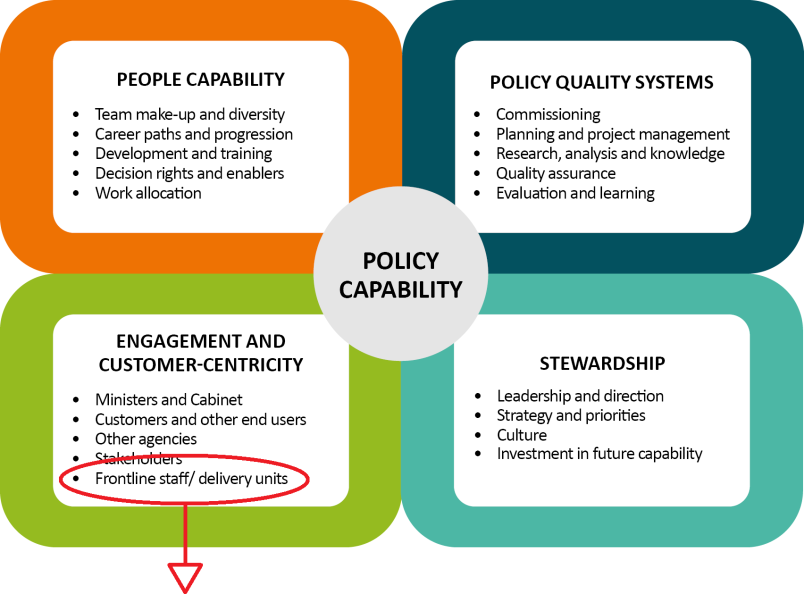
Elements of the Policy Capability Framework
Element Lead question Lines of inquiry
Frontline staff / delivery units

How well does the policy team engage across the agency, including with delivery units?

Are policy processes characterised by end-to-end partnerships between the policy team and other agency staff?

How well does the policy team engage with delivery / frontline units (including delivery staff in other agencies where applicable) to understand the interface with end users and implementation requirements? Does implementation typically proceed smoothly, with room for iteration, without being negatively impacted by unforeseen issues?

There are lead questions and lines of inquiry for the different elements to guide agencies in having a conversation about performance and identify priority areas for improvement. Maturity ratings (see below) are available for agencies to apply. When using the maturity ratings, agencies consider their current performance and where they want to get to in the future, and on that basis strategise to identify the actions needed to get there.

  • Informal – Ad hoc practices that are person, team and/or situation specific
  • Enabled – Policy processes, capability and support systems in place
  • Practiced – Formal systems and practices enacted, generally effective but require concerted effort to embed
  • Embedded – Systems and practices part of culture, used consistently and confidently, record of success. Regular review drives continuous improvement

Enabling a conversation on policy performance#

“In our early thinking about the future direction of IR’s policy function, the Policy Capability Framework gave us a frame of reference that we could meaningfully connect with. We realised that the challenges IR policy was facing were not unique to us, and it gave us the confidence that we were on the right track with our thinking. Drawing connections to the framework helped us tell that story with our people”

Carolyn Elliott, Acting Policy Lead

By applying the Policy Capability Framework, IR was able to demonstrate the broader trends, such as changing customer expectations, were not unique to IR but something the policy system overall was responding to through a customer centric approach. The Policy Capability Framework used language and framed the issues in a way that resonated with the policy staff and connected with their identity as an advisor and steward of the tax system.

IR engaged internal and external stakeholders to seek their views on how IR policy was performing and how it could improve in the future. The outcomes of this engagement affirmed the relevance of the Policy Capability Framework and its fitness-for-purpose for IR’s required capability uplift. Workshops were held with policy staff to work through the findings and what this meant for how they develop policy and the changes needed for the future.

IR used the Policy Capability Framework’s frame of reference to have conversations about policy performance. The outcome was a new operating model for IR policy that is future focused and responds to the broader trends, such as changing customer expectations.

A new operating model for Inland Revenue policy#

The new operating model for IR policy is underpinned by three critical shifts in the ways of working and five enablers to deliver the critical shifts.
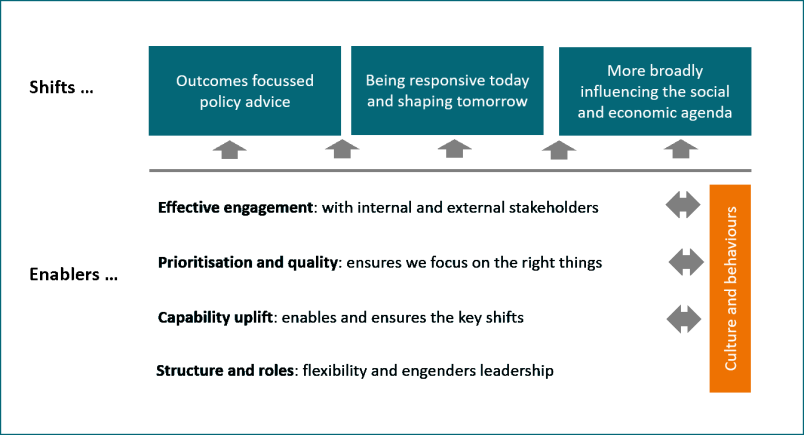
IR Case Study Flow Shifts Enablers

To support the critical shifts in ways of working, IR policy has moved to a new structure. This involves larger flexible teams organised around products and customer types known as 'domains’ (e.g. business and entity taxation, families and individuals). As part of the agile approach to working, project and networked teams are formed as needed across the policy domains and the wider organisation.

The aim is for the new IR policy operating model to result in a difference for staff, leaders, the organisation and the customer.

What will staff notice is different?
  • “We are more open and can contribute ideas which support government’s broader objectives.”
  • “We collaborate and engage with customers to co-design solutions.”
  • “Involving a diverse range of people means we get a better range of innovative ideas.”
What will leaders notice is different?
  • “Our people combine their technical knowledge and expertise with input from others to develop better solutions.”
  • “Our people know how to engage effectively with a diverse range of customers through the policy design process, which means we have better policy outcomes.”
  • “We are a key player at the table, along with the Treasury, Ministry of Social Development, Ministry of Primary Industries, and the Ministry of Business, Innovation and Employment.”
What will IR notice is different?
  • “IR’s policies are more connected with the government’s economic and social objectives. We’re connected to our purpose.”
  • “We have policy solutions that are evidence based, and understood by our customers.”
  • “Prototypes that policy develops and tests are well thought through and consider a range of perspectives.”
What will customers notice is different?
  • “Policy development at IR is innovative, and sustainable over time.”
  • “Better connections across government have helped contribute to vibrant, healthy, and sustainable communities.”
  • “IR understands my situation, and we’ve worked together to develop a solution that works for New Zealanders.”

Continued focus key to improvement#

“We have a number of shifts to achieve that can be easily grouped under a global description of ‘just being better at developing and providing policy advice’. And that sort of generalised aspiration isn’t very helpful. The benefit of the Policy Capability Framework and the maturity matrix is that, we understand what they mean and they help us to be specific and to target capabilities that we want to improve”

Mike Nutsford, Policy Lead

IR policy has committed to applying the Policy Capability Framework every six months as a policy team health check. These checks help track where they are now and what they need to change to fully embrace the new operating model. The results of applying the Policy Capability Framework is one indicator IR uses, among others, to track progress of the business transformation programme in the policy area.

Every six months, IR brings together a cross-section of their policy function to form a Policy Capability Review Team. They also invite people from other areas (e.g. HR, Research, Strategy) to join the Review Team to provide a non-policy perspective.

As a conversation prompt during the review, each member is asked to signal which maturity rating they think best describes IR for each of the capability elements in the Policy Capability Framework. Drawing on evidence and examples, they discuss the ratings as a group to arrive at a single maturity rating for each capability element.

IR uses the maturity rating scale to provide a rating for each of the capability elements, and then calculates an average score out of four for their overall policy capability. Based on the maturity ratings and what’s important to IR, they identify the three capability elements they want to focus on maturing and identify the steps they will take to achieve this. For example, in FY2018-19 IR focused on improving engagement of other agencies and stakeholders, enhancing planning and project management and quality assurance, and policy outcomes and building capability for the future.

Inland Revenue’s tips for applying the Policy Capability Framework#

  • High maturity isn’t required for every capability. Agencies don’t need to achieve ‘embedded’ maturity for every capability element. Different elements will be more important than others, depending on your agency’s context.
  • Lower maturity doesn’t mean the agency’s policy advice is poor. The maturity ratings don’t reflect the quality of your agency’s policy advice, but identify the capabilities for improvement to deliver quality advice into the future.
  • The conversation is important. Taking time to have the conversation about policy capability is as important as the maturity ratings.
  • Don’t moderate to the middle. Be careful when moderating the conversation to not move to the middle maturity for every capability element.
  • Pros and cons of referring to previous results. Referring to the results of the last Policy Capability Review helps track performance, but may bias the assessment of current performance.  

Emma Grigg photo

A senior leader’s perspective#

“We felt we were already a good ‘Policy Shop’ and this was backed up by feedback from ministers – yet we also realised that to stay at the front of our game we would have to continuously improve our capability. The Policy Capability Framework gelled with us and I will be using the capability maturity matrix to help me track whether or not we are achieving our development goals”

Emma Grigg, Acting Deputy Commissioner


How the Policy Capability Framework can help#

IR continues to apply the Policy Capability Framework as a regular health check with a view to helping to:

  • maintain focus – regularly applying the Policy Capability Framework keeps IR’s focus on the outcomes it wants to achieve.
  • make it real – the Policy Capability Framework helps make the new operating model real for people and the concrete steps that are needed to get there.
  • identify issues early – identifying any issues early through regularly applying the Policy Capability Framework means they can be addressed before they become problems.
  • align with best practice – IR uses the Policy Capability Framework to align with best practice and build consistency in how the system thinks about policy capability.
  • enable staff – staff are enabled to take the initiative to act in ways that align with the desired capabilities identified through applying the Policy Capability Framework.


  • Previous
  • Next
Sidebar anchor
View all on one page
Show content paged
Print this publication

Table of Contents

  1. Improving policy capability
    1. Inland Revenue’s business transformation journey
    2. The challenge for policy
    3. The Policy Capability Framework
    4. Enabling a conversation on policy performance
    5. A new operating model for Inland Revenue policy
    6. Continued focus key to improvement
    7. Inland Revenue’s tips for applying the Policy Capability Framework
    8. A senior leader’s perspective
    9. How the Policy Capability Framework can help

Related publications

A guide to policy sprints: How to run a successful sprint team

Resources
27 Feb 2026

A guide for panels assessing policy advice papers with the Policy Quality Framework

Resources
22 Sep 2025

Writing for Ministers and Cabinet

Resources
5 Sep 2025

Start Right Guide

Resources
1 Sep 2025

Developing slides for policy advice

Resources
19 Aug 2025

Policy Quality Framework

Resources
30 Jul 2025
View all publications

Content wrapper

Help us improve DPMC

Your feedback is very important in helping us improve the DPMC website.


More menu anchor
Home Department of the Prime Minister and Cabinet (DPMC)
Page url

Toitū carbon reduce ISO 14064-1 organisation

Back to top

About DPMC
  • Who we are
  • Our work
  • Our history
  • Careers
Our business units
  • Cabinet Office
  • National Security and Resilience Group
  • Policy Advisory Group
  • Delivery Unit
  • Corporate
  • Government House
Our programmes
  • New Zealand Royal Honours
  • The Policy Project
  • Government Targets
  • National security
  • Other work
  • Risk and resilience
Publications
  • Publications
  • News and notices
  • Annual reports
  • CabGuide
  • Cabinet Manual
  • Contact us
  • Copyright and licensing
  • Privacy
  • About this site
  • Disclaimer
  • Site map

© Copyright Department of the Prime Minister and Cabinet.

New Zealand Government